The shot tasted wrong again. Not sour, not bitter, just muddy, indistinct, like someone had taken a good espresso and rubbed the edges off it. The grinder was a well-regarded flat burr model, the beans were fresh, the puck prep was clean. Dose, yield, time: all in range. Then a friend watching over the shoulder said, almost as an aside, “Have you checked your burr alignment?” The question felt almost too basic. Of course the burrs were aligned, this wasn’t a $40 blade grinder from a supermarket. But they weren’t. Not even close.
Burr alignment is the one variable that determines grind consistency more directly than any specification a manufacturer actually publishes. You’ll find burr diameter in millimeters, RPM, motor wattage, hopper capacity, and sometimes particle size distribution curves in press materials. What you almost never find is how parallel the two burr faces are to each other, or how precisely they share a rotational axis. That omission isn’t an accident, alignment is expensive to get right, it’s hard to verify without specialized tooling, and naming it would force an honest conversation about why two grinders using the same 64mm flat burrs can produce dramatically different cups.
What Burr Alignment Actually Means
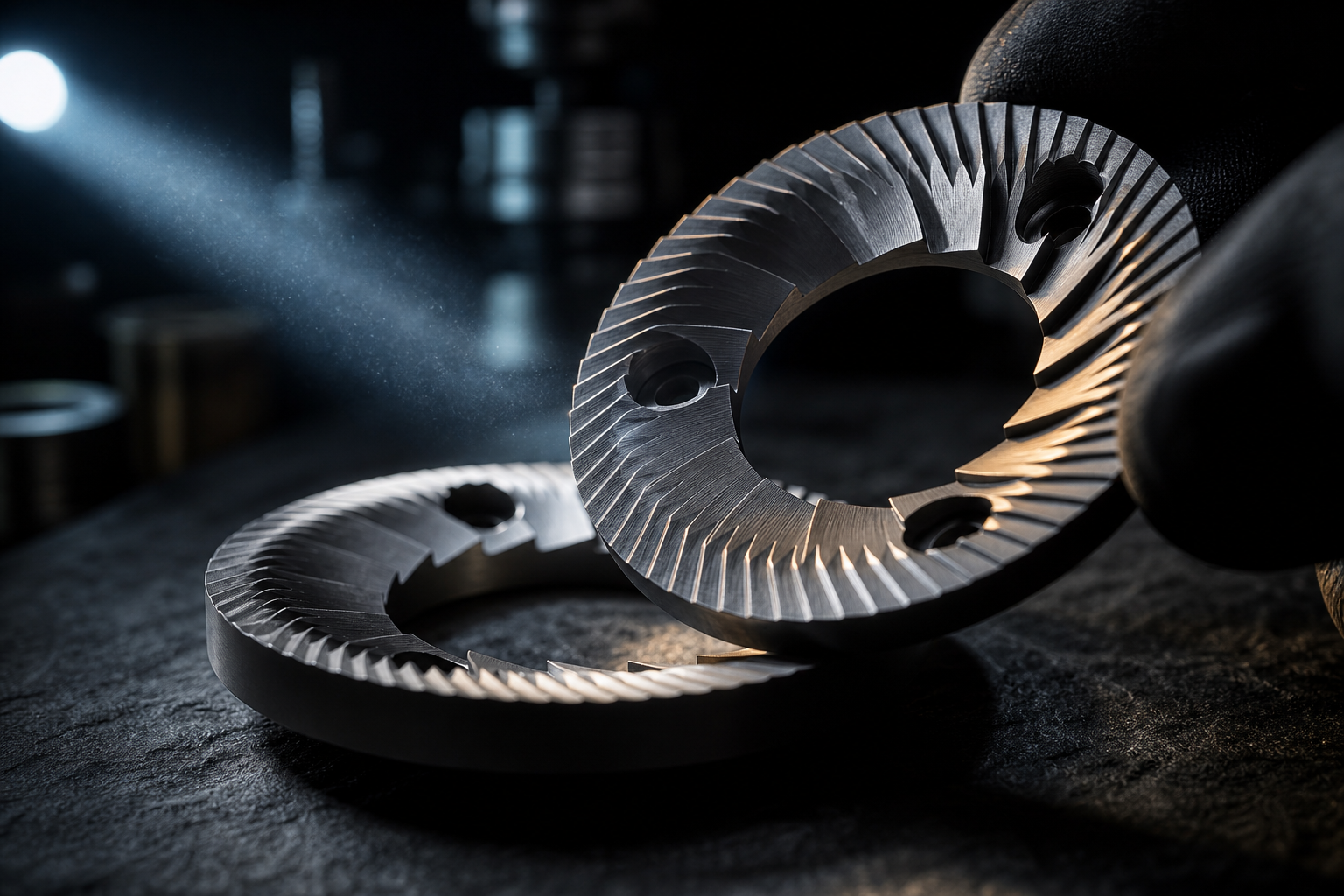
A grinder has two burrs: one stationary, one spinning. Coffee grounds down the gap between them. The assumption most people carry is that “grinding at a 20” or “four clicks coarser” sets a fixed, uniform gap around the entire burr face. Alignment is about whether that assumption is true.
There are two distinct problems. The first is axial misalignment, also called wobble: the spinning burr doesn’t rotate on a perfectly perpendicular axis, so one side of it dips closer to the stationary burr with every revolution. The second is planar misalignment: the two burr faces aren’t parallel, so even if the burr spins true, one quadrant of the grinding surface sits closer than the opposite quadrant. Both produce the same downstream problem, some coffee particles travel through a tight gap while others travel through a wide one, and you end up grinding two or three effective grind sizes simultaneously.
That mixture is the real enemy. A grind that’s too coarse in one spot will under-extract. A grind that’s too fine in another will over-extract and contribute bitterness or astringency. What you taste isn’t cleanly either flaw, it’s both at once, which is why a poorly aligned grinder often produces cups that resist easy diagnosis. You adjust coarser and the sourness doesn’t fully leave. You adjust finer and it gets muddier before it gets better. The grinder is giving you a moving target because the effective gap isn’t a single number.
Why Manufacturers Don’t Lead With This
Burr diameter is a clean marketing number. A 64mm flat burr sounds better than a 54mm flat burr. Higher RPM sounds like more power. These are real numbers that correspond to real engineering decisions, and some of them do matter (burr diameter does affect throughput and heat generation). But none of them guarantee alignment, and some of the design choices that improve the marketable specs can actually make alignment harder to achieve.
Consider the motor mounting. Budget and mid-range grinders typically press-fit their burr carrier directly onto the motor shaft. Motor shafts have manufacturing tolerances, a few hundredths of a millimeter of runout is normal and considered acceptable for most applications. For grinding coffee, a few hundredths of a millimeter is significant. Matt Perger, whose work on espresso variables at Barista Hustle has pushed a lot of home-barista thinking forward, has written about this directly: the grinders that consistently produce the tightest particle distributions are almost always the ones with the most rigid, precisely machined burr carrier systems, regardless of the burr’s nominal diameter.
Higher-end grinders solve this in a few ways. Some use a separate bearing cartridge for the upper burr carrier so it’s decoupled from motor shaft runout. Some use thicker, more precisely machined burr seats that locate the burr on a machined step rather than relying on friction alone. A few allow the user to shim the upper burr carrier, adding or removing thin metal washers to correct planar tilt. The Kafatek Monolith, the Titus Grinding platforms, and some of the high-end Weber Workshops grinders are built with this kind of adjustability in mind. At the opposite end, some sub-$200 grinders come from the factory with misalignment measurable in the tenths of a millimeter range, which is audible in the cup.
How to Test Your Own Grinder
You don’t need a dial indicator or a machine shop to get a useful read on your grinder’s alignment. The two most accessible methods are the marker test and the Sharpie test (they’re related but work at different stages).
For the marker test, remove the upper burr and use a Sharpie or similar marker to color the entire grinding surface, the teeth and the flat face between them. Reassemble the grinder, run it without coffee for a few rotations at a slow manual pace (if it’s a hand grinder) or for a brief burst (if electric), then remove and inspect the upper burr again. Where the ink has been worn away by contact with the lower burr, the gap is at zero or near-zero. Where the ink remains intact, there’s clearance. A well-aligned grinder will show even wear across the whole face. A misaligned one will show a crescent or wedge of contact on one side and untouched ink on the opposite side.
A simpler proxy is the chirp test. Tighten the adjustment until the burrs just barely touch and you hear a grinding chirp. Back off until the chirp stops, that’s your zero point. Now rotate the burr carrier slowly by hand and listen. If the chirp comes and goes as the carrier rotates, the spinning burr is wobbling in and out of contact. That wobble is axial misalignment. A well-aligned grinder will chirp consistently with no variation around the rotation.
For hand grinders, you can also set the grinder to its finest (tightest) setting and hold the central shaft still while slowly turning the outer body. Feel for resistance variation around the rotation. Uneven drag at zero gap is the same signal the chirp test produces audibly.
The Real-World Impact, by Brew Method
Misalignment doesn’t hurt every brew method equally. The brewing method determines how forgiving the system is of a wide particle size distribution.
Espresso is the most punishing context, by a significant margin. The high pressure and short contact time mean there’s almost no room to average out uneven extraction. Fine particles over-extract almost instantly; coarse particles under-extract and contribute sourness; the result is a muddled shot where no amount of recipe adjustment fully resolves the flavor. If your espresso shots taste inconsistent even when your technique is locked in, misalignment is one of the first things to investigate, before you blame the beans, the machine, or the pressure profile.
Pour-over is more forgiving, but not immune. A wide particle size distribution will show up as a cup that lacks clarity, flavors present but indistinct, like hearing music through a wall. You can compensate somewhat with grind size (grinding coarser to reduce fines) but you’ll sacrifice extraction efficiency in the process. Brew ratio does a lot of work in pour-over, but it can’t redistribute extraction across a bimodal particle spread. You’ll end up chasing a balance that the grinder isn’t capable of delivering.
French press and immersion methods are the most tolerant. The longer contact time averages out some of the variation, and you’re filtering less precisely, fines stay in the cup, coarses keep extracting. The cup won’t be as clean as a well-aligned grinder would produce, but the misalignment won’t wreck it the way it wrecks an espresso.
What You Can Actually Do About It
The honest answer is: it depends on the grinder.
On many consumer grinders, the burrs are pressed onto seats that weren’t designed to be adjusted, and the chassis tolerances are set in manufacturing. Short of returning the unit or sending it to a specialty repair shop, there’s limited user intervention. But a few things are worth trying before giving up.
First, check whether the upper burr is fully and correctly seated. On many grinders, the upper burr presses into a carrier with small clips or a twist-lock. If it’s not fully seated, even by a fraction, that will introduce tilt. Remove, clean the seat of any coffee residue, and reseat firmly. Run the marker test again. Sometimes the fix is this simple.
Second, check whether the burr is the problem or the carrier. Some grinders allow the upper burr carrier to be loosened and the burr itself to be repositioned slightly before re-tightening. If you have the tools to measure runout (a dial indicator and a small V-block or lathe isn’t outrageously specialized), you can identify whether the shaft, carrier, or burr face is the source of the misalignment and address each independently.
Third, consider shimming. On grinders where the community has developed alignment kits, the 1Zpresso J-series, the Comandante C40 MK4, the Niche Zero, and several others have active hobbyist communities around this, thin brass or stainless shims placed under one side of the upper burr carrier can correct a planar tilt. The approach requires careful iterative testing (marker test, shim, marker test again) and a steady hand, but it has genuinely transformed grinders for people who’ve done it carefully. The Home-Barista forums carry detailed alignment walkthroughs for dozens of specific grinder models, search for your model name alongside “alignment” before attempting anything.
Fourth, and most practically: if you’re shopping for a grinder and alignment matters to you, look for community reports on the specific model, not just the spec sheet. The Barista Hustle blog has published on particle distribution and grinder design in ways that give you a framework for reading those reports critically. Models with known tight factory tolerances (often flagged in community reviews as “consistently great out of the box”) are meaningfully different from models that “vary unit to unit”, that variation phrase is often code for alignment variance between production units.
A Practical Heuristic for Buying Decisions
Here’s a rule that actually holds: unit-to-unit consistency in community reviews is a better proxy for alignment quality than burr diameter. When reviewers of a $180 grinder all report similar results, and reviewers of a $220 competitor report wide variance, “mine is great, mine is terrible”, that variance is often alignment. The higher-priced option with consistent reports is almost always the better grinding platform, regardless of whose burrs are nominally larger.
This matters most in the $150 to $400 range, where the burr sizes start to converge and the real differentiation is in the machining precision that holds those burrs in plane. At under $150, alignment is almost never a focus in design. At over $500, most manufacturers have made it a priority whether or not they say so explicitly. The middle range is where the question is genuinely unsettled and where the community reports earn their value.
At the same time, a grinder’s alignment isn’t always fixed. It can shift slightly if the grinder is dropped, if the burrs are removed and reseated carelessly after cleaning, or if a burr carrier clip wears down over years of use. Running the marker test once a year, especially after any maintenance, takes about five minutes and gives you real data rather than assumptions.
Why This Changes How You Diagnose Problems
Most home brewers reach for recipe variables first when something is off: adjust the grind size, change the ratio, tweak the water temperature. That’s usually the right first move. But there’s a category of cup problems that recipe adjustment genuinely cannot fix, and that category is larger than most people realize. A wide, poorly controlled particle size distribution produces extraction patterns that no ratio or temperature setting can fully correct, you’re tuning around a hardware limitation.
The practical implication is this: if you’ve genuinely dialed in your recipe, if your technique is consistent, and if the cup still produces flavors that resist description as clean sourness or clean bitterness, if the problem is flatness, muddiness, or a shot that tastes like it’s trying to be good but isn’t quite making it, run the marker test before you buy more beans or change your water. The answer might already be in your grinder.
Grinder spec sheets will keep listing burr diameter and RPM because those numbers are easy to communicate and hard to argue with. Burr alignment is a precision engineering problem that shows up as a flavor problem, which is exactly why it gets skipped over. Understanding it won’t change what’s printed on the box. But it will change what you listen for when the shot isn’t right.