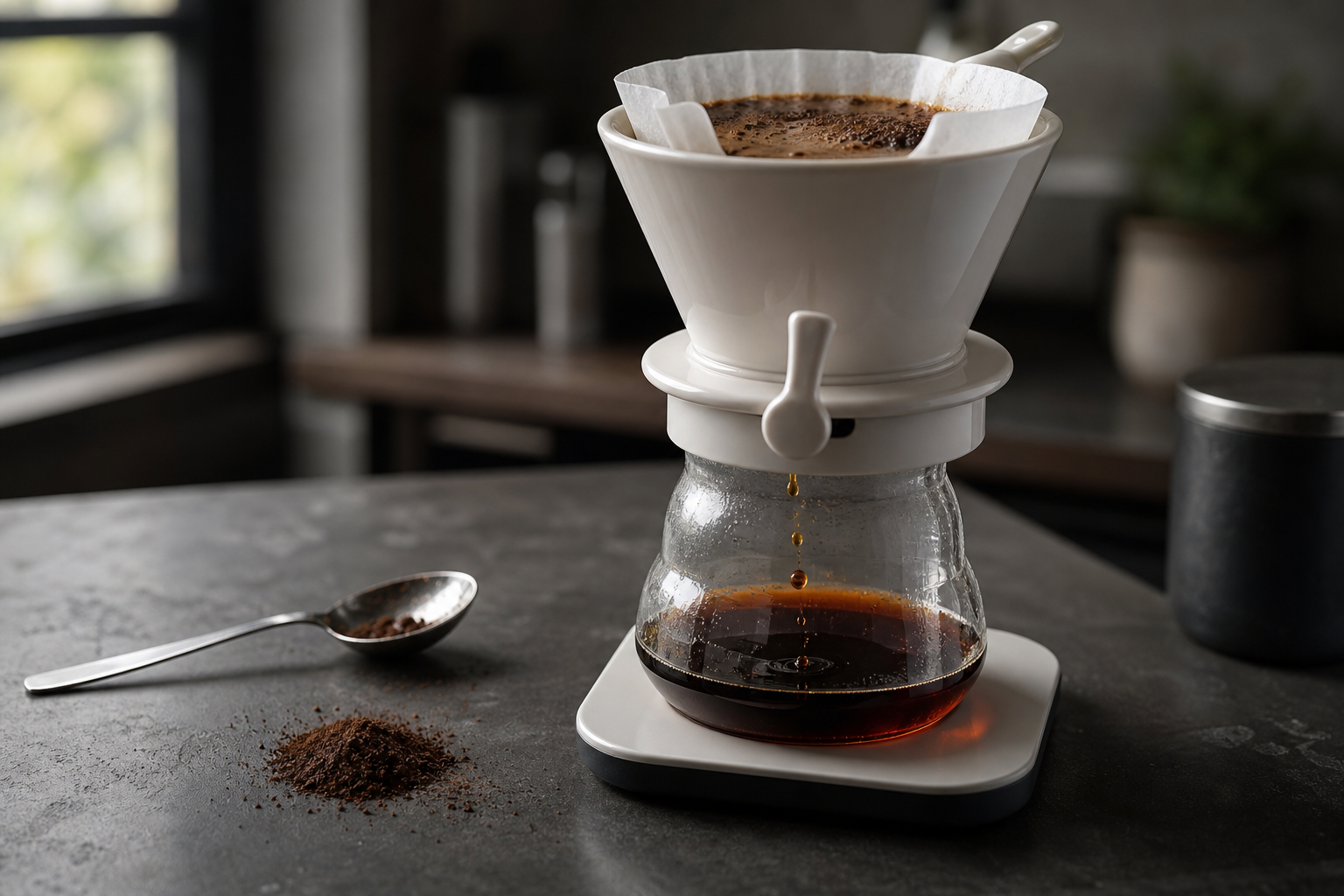
Fewer than 1% of home brewers own a brewer that changes its own extraction physics mid-brew. The Hario Switch’s dual-path design (immersion followed by a flat-bottomed paper filter) is the only reason it produces a cup that tastes like both a French press and a V60. The mechanism is simple, but the result is a specific extraction profile that no other home brewer can replicate without buying two separate pieces of gear.
When you flip the switch, you’re not just changing the flow rate. You’re changing the extraction physics. The immersion phase extracts the heavy, oily compounds and body. The flat-bottom filter then catches the fines that would normally make a French press muddy, while letting the bright, acidic solubles through. The result is a cup with more body than a pour-over and more clarity than a French press. It’s a hybrid extraction, and it works because the hardware forces it.
Most people buy the Switch because they want one brewer to do everything. That’s a mistake. The Switch is a precision tool for a specific type of hybrid extraction. If you treat it like a standard pour-over, you’ll get a thin, watery cup. If you treat it like a French press, you’ll get a muddy, over-extracted mess. The trick is understanding the two distinct phases and how they interact.
The Immersion Phase: Why You Must Wait
The first phase is immersion. You add your coffee, add your water, and stir. Then you wait. Most people rush this. They wait 30 seconds, flip the switch, and wonder why the cup tastes sour and thin. The immersion phase needs 1:30 to 2:00 minutes. This is where the heavy, oily compounds and the larger, less-soluble molecules have time to dissolve into the water. Without this wait, you’re just making a very slow, very inefficient pour-over.
Stirring during this phase is non-negotiable. You need to saturate every particle. If you don’t, you’ll have dry pockets of coffee that never extract, leading to a sour, astringent cup. Use a spoon or a dedicated stirring tool. Make sure the bed is uniform. This is the foundation of the body you’re trying to achieve.
The Flat-Bottom Filter: The Secret Weapon
Here’s where the Switch diverges from every other immersion brewer. The filter is flat-bottomed, not cone-shaped. A cone filter forces water through a single point, creating a longer path and a higher chance of channeling. A flat-bottom filter allows water to flow through the entire bed simultaneously. This is why the Switch can produce a cup with more body than a cone-filter pour-over without the sediment of a French press.
When you flip the switch, the water drains through the flat paper. The paper catches the fines (the tiny particles that cause bitterness and astringency) but lets the larger, flavorful molecules through. This is the clarity you’re after. It’s the same reason a Kalita Wave produces a cleaner cup than a V60, but the Switch gets it while also doing immersion.
The Ratio and Grind: Where Most People Fail
The Switch demands a specific grind size. If you grind too fine, the flat filter clogs, and you get a bitter, over-extracted cup. If you grind too coarse, the water flows too fast, and you get a sour, under-extracted cup. The sweet spot is medium-fine, slightly coarser than espresso but finer than a standard pour-over. Think of it as the grind you’d use for a Chemex, but slightly finer.
The ratio is equally critical. A 1:16 ratio is the standard starting point. 15 grams of coffee to 240 grams of water. If you’re using a lighter roast, bump it to 1:15. If you’re using a darker roast, drop it to 1:17. The Switch is sensitive to ratio changes because the dual-phase extraction amplifies any imbalance. A slightly off ratio will taste much more extreme than it would in a standard pour-over.
Agitation: The Hidden Variable
Agitation during the immersion phase is what most people overlook. Stirring once at the start is enough. Do not stir again after the bloom. Agitation after the bloom creates turbulence that pulls fines into suspension, which the flat filter can’t catch fast enough. This leads to a muddy cup. Stir once, wait, flip, and pour. That’s it. The less you interfere, the cleaner the cup.
If you want more body, stir harder during the initial bloom. If you want more clarity, stir gently. This is the fine-tuning knob on the Switch. It’s subtle, but it makes a noticeable difference in the final cup.
Why This Matters for Your Home Setup
The Switch isn’t a gimmick. It’s a specific solution to a specific problem: how to get body and clarity in one brewer. If you’re tired of buying a French press and a V60, the Switch is the only piece of gear that does both. But it requires respect for the two phases. Treat it like a pour-over, and you’ll be disappointed. Treat it like a French press, and you’ll be disappointed. Treat it like a hybrid extraction tool, and you’ll get a cup that’s uniquely yours.
It’s not about the gear. It’s about understanding the physics of the dual-path design. Once you do, the Switch stops being a novelty and starts being your daily driver.