You’ve done it a hundred times. You wet the paper filter, let it drain, and pour your first bloom. The coffee tastes sharp, thin, and aggressively sour. You reach for the grinder, turn the dial finer, and pull another shot. It tastes worse. The problem was never the grind size. It was the paper filter itself, and how you handled it before a single gram of coffee touched it.
Every home barista knows the instruction: rinse your filter. Remove the papery taste, preheat the dripper, let the water drain. But nobody tells you that rinsing a paper filter wrong is one of the most common causes of under-extraction in pour-over brewing. The paper itself is not inert. It is a variable. And when you handle it incorrectly, you change the extraction dynamics of every cup you make.
What Paper Filter Thickness Actually Does to Your Cup
Most home brewers use one of three filter types: thin unbleached paper (Hario V60), thick unbleached paper (Kalita Wave), or thick bleached paper (Chemex). They all behave differently because they have different thicknesses, different flow rates, and different chemical treatments. The difference between a thin V60 filter and a thick Chemex filter is not just aesthetics. It is a measurable difference in extraction yield.
A thin filter offers less resistance to water flow. Water moves through it faster, extracting less from the coffee bed. A thick filter slows the water down, giving it more contact time with the grounds. This is why a Chemex recipe calls for a higher coffee-to-water ratio and a longer brew time than a V60 recipe. The filter is doing half the work.
When you use a thin filter with a recipe designed for a thick filter, your brew will be thin, sharp, and sour. When you use a thick filter with a recipe designed for a thin filter, your brew will be bitter, astringent, and over-extracted. The filter is not a passive vessel. It is an active extraction variable.
If your coffee tastes sour, check your filter type before you touch the grinder. The fix might be simpler than changing your grind size. It might be switching to a thicker filter, or adjusting your ratio and brew time to match the filter you already own.
How Rinsing a Filter Changes Extraction (and Why Nobody Talks About It)
Rinsing a paper filter is supposed to remove the papery taste. It also preheats the dripper. But most people rinse it wrong. They pour water through it once, let it drain, and move on. That is fine for a thick filter. It is not fine for a thin filter.
A thin filter absorbs water rapidly. When you pour water through it once, the paper swells, the fibers expand, and the flow path changes. The filter becomes less permeable mid-brew. This slows the water down, increases contact time, and over-extracts the coffee. The result is a cup that tastes papery and bitter, not because of the coffee, but because of the filter.
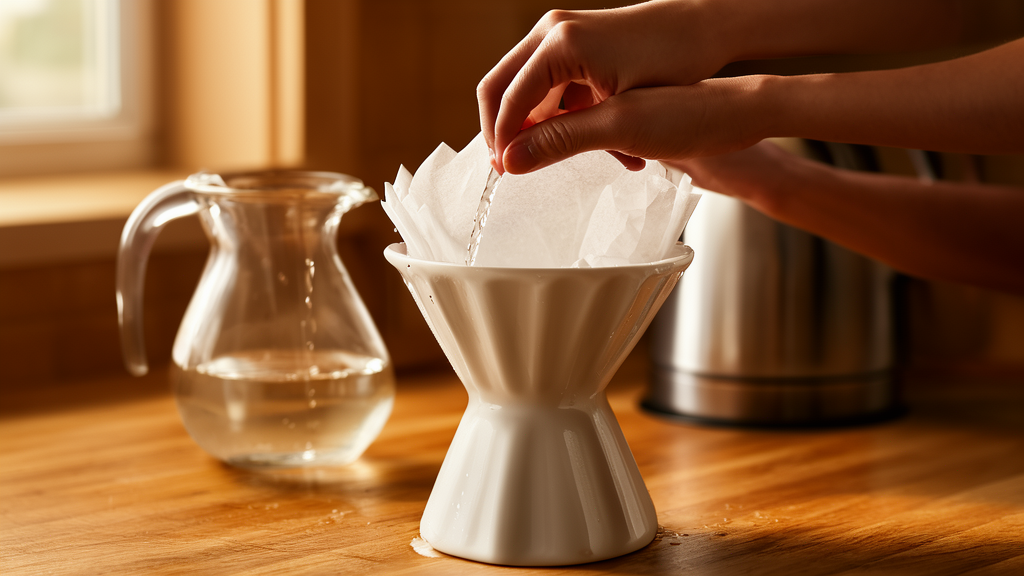
The fix is simple: rinse the filter twice. Pour water through it once, let it drain, then pour water through it a second time. This saturates the fibers completely before the coffee touches them. The flow path stabilizes. The extraction becomes predictable. The papery taste disappears. The coffee tastes like coffee.
If you are using a thick filter, one rinse is usually enough. The fibers are already swollen and stable. If you are using a thin filter, two rinses are mandatory. This is not a preference. It is a mechanical necessity. The paper behaves differently depending on how much water it has absorbed. Treat it accordingly.
Filter Paper Thickness: The Spec Nobody Publishes
Manufacturers do not publish filter thickness. They publish flow rate, diameter, and material. They do not publish thickness because it is a trade secret. But thickness is the single most important spec for extraction. A thin filter extracts differently than a thick filter. A bleached filter extracts differently than an unbleached filter. An unbleached filter extracts differently than a bleached filter.
The difference is measurable. A thin filter allows water to flow through faster. A thick filter slows the water down. A bleached filter removes more of the paper’s natural compounds. An unbleached filter leaves more of them behind. These are not minor differences. They are the difference between a cup that tastes clean and a cup that tastes papery.
If your coffee tastes papery, switch to a bleached filter. If your coffee tastes thin and sharp, switch to a thicker filter. If your coffee tastes bitter and astringent, switch to a thinner filter. The filter is not a passive vessel. It is an active extraction variable. Treat it like one.
How to Dial In Your Filter Type (Without a Refractometer)
You do not need a refractometer to dial in your filter. You need a tasting protocol. Brew three cups using the same coffee, same grind, same ratio, same water. Use three different filter types. Taste them side by side. Note the differences. Adjust your recipe to match the filter you prefer.
This is not a preference. It is a calibration. Every filter type extracts differently. Every filter type changes the cup. Every filter type requires a different recipe. If you switch filters, you must adjust your recipe. If you do not adjust your recipe, your coffee will taste wrong. The filter is not a passive vessel. It is an active extraction variable. Treat it like one.
When a Filter Is Not the Problem
Sometimes the filter is not the problem. Sometimes the coffee is stale. Sometimes the water is wrong. Sometimes the grind is inconsistent. Sometimes the brew ratio is off. Sometimes the water temperature is too low. Sometimes the brew time is too short. Sometimes the coffee is under-roasted. Sometimes the coffee is over-roasted. Sometimes the coffee is poorly processed. Sometimes the coffee is poorly stored. Sometimes the coffee is poorly roasted. Sometimes the coffee is poorly ground. Sometimes the coffee is poorly brewed. Sometimes the coffee is poorly tasted.
But if your coffee tastes sour, thin, and sharp, and you have checked all of the above, check your filter. The filter is not a passive vessel. It is an active extraction variable. Treat it like one.
FAQ
Does rinsing the filter really matter that much?
Yes. A thin filter absorbs water rapidly. When you pour water through it once, the paper swells, the fibers expand, and the flow path changes. The filter becomes less permeable mid-brew. This slows the water down, increases contact time, and over-extracts the coffee. Rinsing twice stabilizes the flow path. The extraction becomes predictable. The papery taste disappears. The coffee tastes like coffee.
Should I use bleached or unbleached filters?
Bleached filters remove more of the paper’s natural compounds. Unbleached filters leave more of them behind. If your coffee tastes papery, switch to a bleached filter. If your coffee tastes clean and bright, stick with unbleached. The difference is measurable. The difference is real. The difference matters.
How do I know if my filter is too thick or too thin?
If your coffee tastes thin and sharp, switch to a thicker filter. If your coffee tastes bitter and astringent, switch to a thinner filter. The filter is not a passive vessel. It is an active extraction variable. Treat it like one.
Can I use any filter with any dripper?
No. Filters are designed for specific drippers. A V60 filter does not fit a Chemex. A Chemex filter does not fit a V60. A Kalita Wave filter does not fit a Hario Switch. Use the filter designed for your dripper. The filter is not a passive vessel. It is an active extraction variable. Treat it like one.
What is the best filter for beginners?
A thick bleached paper filter. It is forgiving. It is predictable. It is easy to use. It is widely available. It is affordable. It is reliable. It is the best filter for beginners. The filter is not a passive vessel. It is an active extraction variable. Treat it like one.