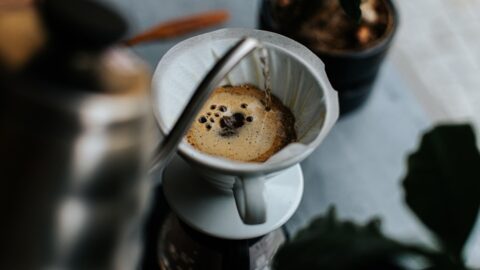
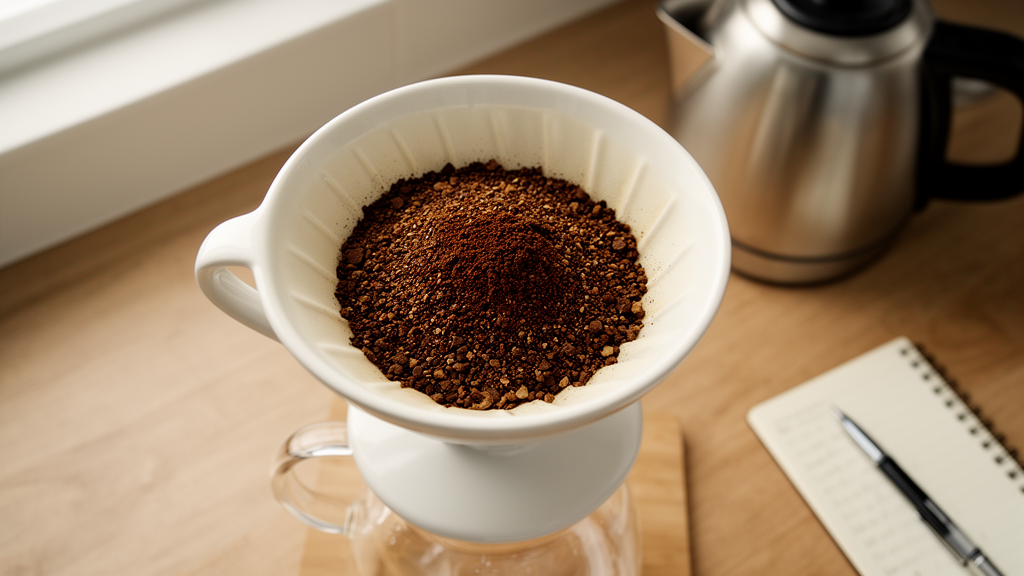
You’ve set the grind to the middle of your grinder’s range, dialed in your ratio to 1:16, and preheated the kettle to 93°C. The water hits the bed and disappears instantly, leaving behind a flat, watery cup. You reach for the dial, click it finer, and wait. The water pools. The cup turns bitter. You click it finer again, and the brew drags on for four minutes, extracting every last astringent compound the bean has to offer. This is the grind-size trap, and it’s not about your dripper. It’s about the particle distribution your grinder actually produces.
Most home brewers treat grind size as a single dial. They assume that if they land on the same click count on any burr grinder, the extraction will behave the same way. That assumption is wrong. The real variable is not the average particle size, but the width of the distribution curve. A grinder that produces a broad spread of particle sizes will extract differently than one that produces a tight, uniform cut, even when both land on the same nominal setting.
Consider the difference between a blade grinder and a properly aligned flat burr. A blade grinder chops beans into a chaotic mix of boulders, fines, and everything in between. The fines over-extract and create bitterness. The boulders under-extract and leave the cup hollow. A flat burr grinder, when set correctly, produces a much tighter distribution. The fines are minimized, the boulders are reduced, and the middle gets the bulk of the mass. The result is a cleaner, more balanced extraction at a coarser setting than you’d expect.
This is why your V60 tastes sour when you follow a standard recipe. The recipe assumes a certain particle distribution. If your grinder produces more fines than the recipe expects, those fines will over-extract and mask the bright acids you’re trying to pull. You compensate by going coarser, which opens the flow rate, but then you lose body and clarity. The solution is not to chase the perfect click number. It’s to understand what your specific grinder is actually doing to the bean.
Let’s look at the math. Extraction yield is a function of surface area. Smaller particles have exponentially more surface area exposed to water. A distribution curve that skews fine will extract 22% or higher, pulling out the bitter, astringent compounds that live in the bean’s structural fibers. A distribution curve that skews coarse will sit at 15%, leaving behind unextracted sugars and acids. The goal is not to hit a magic number. The goal is to balance the curve so that the fines and boulders cancel each other out at the target yield.
How do you test this at home? You don’t need a refractometer. You need a simple taste test. Brew two cups using the same bean, same ratio, same water. Dial one in at the middle of your grinder’s range. Dial the other in two clicks finer. Taste them side by side. If the finer grind tastes sharper, more acidic, and cleaner, your grinder is producing a tight distribution. If the finer grind tastes bitter, astringent, and hollow, your grinder is producing a broad distribution with too many fines. The sharper cup is the one you want. The click count that got you there is your real grind setting, not the middle of the dial.
This principle applies to every dripper, not just the V60. The Kalita Wave, with its flat bottom and three holes, is more forgiving of a broad distribution because the water has less path to travel. The Chemex, with its thick paper filter, traps more fines, which can mask a poor distribution. The Hario Switch, when used in pour-over mode, behaves like a V60 but with a flat filter that changes the flow dynamics. Your grinder’s distribution curve is the constant. The dripper is the variable.
So what should you do? Stop chasing the middle of the dial. Start listening to the cup. If your brew is sour, go finer. If it’s bitter, go coarser. But do it in small steps, one click at a time. Taste after every adjustment. Keep a log. Note the click count, the brew time, the ratio, and the taste. Over time, you’ll build a mental map of your grinder’s behavior. You’ll know that click 20 on your 1Zpresso J-Ultra tastes different than click 20 on your Baratza Encore ESP. You’ll know that your Ethiopian natural needs a coarser setting than your Colombian washed. You’ll know that your grinder is not a single dial. It’s a complex machine with a unique fingerprint.
The grind-size trap is real. It’s why so many home brewers feel like they can’t get a consistent cup. They’re adjusting a dial that doesn’t correspond to a single extraction rate. They’re fighting a distribution curve they don’t understand. The solution is not a better dripper. It’s not a more expensive kettle. It’s a willingness to taste, to adjust, and to accept that your grinder is not a standard. It’s a tool with its own personality. Learn its personality. Brew with it. The cup will tell you everything you need to know.