You’ve been grinding finer to fix the sourness. It’s not working. The grinder isn’t broken, the bean isn’t bad, and your brew ratio is probably fine. The problem is a blind spot in your grinder’s burr set that almost no manufacturer discloses, and it is actively turning your carefully dialed-in shots into a chemical mess. Every time you adjust the grind, you are moving that blind spot across the bean bed, changing the extraction profile in ways you cannot see.
Most home espresso brewers blame the bean when a shot pulls sharp and astringent. They grind finer, they dial in the dose, they pull another shot, and the cup still tastes like green apple or unsweetened lemon juice. The standard advice is to check the grind, check the dose, check the water temperature, and check the bean’s roast date. Nobody checks the burr alignment. That is the missing variable, and it is the reason your dial-in protocol keeps failing.
What Burr Alignment Actually Controls
Conical and flat burrs are not perfect circles. They are manufactured with a tolerance stack that leaves one small arc of the burr surface slightly farther from the opposing burr than the rest. That arc is the dead zone. It is a region where the particle size distribution shifts toward larger chunks, regardless of what the grinder’s adjustment ring says. When you set your grinder to 20 clicks, the dead zone might be sitting at the 3 o’clock position. When you change the grind by 4 clicks, the dead zone rotates to 5 o’clock. The average particle size changes, but the distribution curve does not tighten. It just moves.
Scott Rao documented this phenomenon early in the specialty-coffee community, noting that burr alignment controls consistency more than burrs per minute or motor torque. The SCA’s own cupping protocol does not account for it, because it tests ground coffee that has already been mixed. But in a 16-gram espresso puck, unmixed particle distribution is the difference between a balanced shot and a channeling nightmare. The dead zone creates a bimodal distribution: a cluster of fine particles that over-extract, and a cluster of large particles from the dead zone that under-extract. The fines create resistance, slowing the flow. The large particles create low-resistance pathways, allowing water to bypass the fines entirely. The result is a shot that looks dark and syrupy but tastes hollow.
How to Test Your Grinder’s Dead Zone
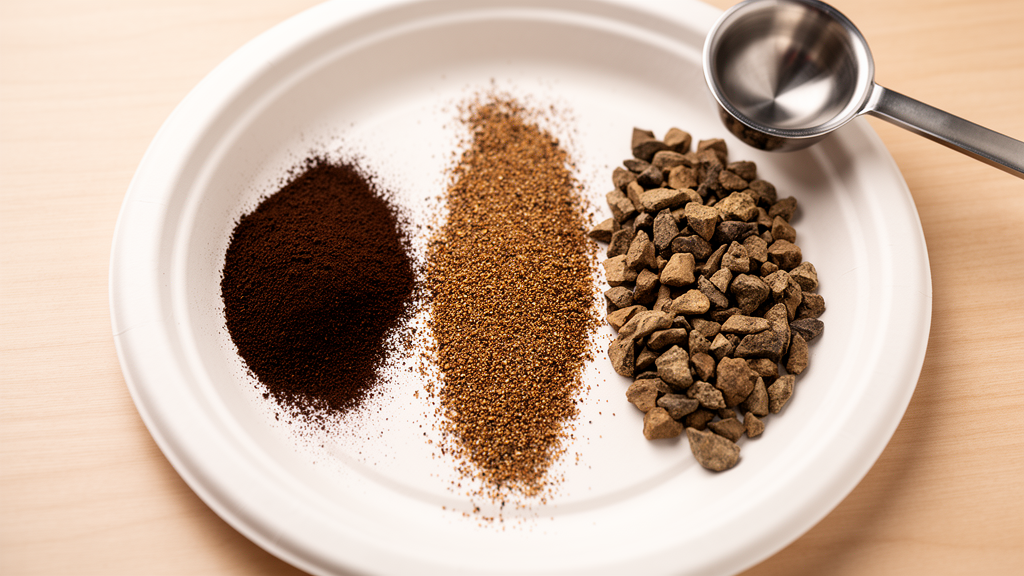
You do not need a microscope to find the dead zone. You need a single-dose workflow and a paper filter. Set your grinder to your normal espresso setting. Single-dose 18 grams into a dosing cup. Pour the grounds onto a white paper plate. Using your fingers, separate the grounds into three visual groups: the dark, fine dust; the medium, sand-like particles; and the large, coarse chunks that look like gravel. Count them. If you see a significant number of large chunks alongside a heavy dust layer, your grinder has a dead zone. A properly aligned grinder produces a unimodal distribution: a single peak of medium particles with a smooth tail of fines and a smooth tail of coarse particles. No gravel. No dust clouds.
Now change the grind by 4 clicks finer. Single-dose 18 grams again. Repeat the separation. If the large chunks have not decreased in number, the dead zone is still present. You have simply moved it. This is why grinding finer does not fix sourness. It increases resistance from the fines, which slows the shot, but the large chunks from the dead zone remain, creating bypass channels. The water flows through the bypass channels, under-extracting those particles, while over-extracting the fines. The cup tastes sour because the large chunks are under-extracted, not because the fines are over-extracted. The fines are doing their job. The dead zone is the problem.
Which Grinders Have the Worst Dead Zones
Not all grinders are equal. The Baratza Encore ESP, one of the most popular entry-level espresso grinders, has a documented alignment issue that creates a noticeable dead zone at coarser settings. The 1Zpresso J-Ultra, a popular manual grinder in the sub-$200 tier, has been tested by independent reviewers to have a tighter alignment, but still exhibits a small dead zone that shifts with grind size. The Fellow Ode Gen 2, a burr grinder released in 2023, uses flat burrs that are more expensive to align, and early units showed a wider dead zone than later revisions. The Rancilio Silvia, a semi-pro espresso machine often paired with entry-level grinders, exposes the dead zone more harshly because its pump pressure is fixed and unforgiving. If you are pulling shots on a Silvia with a poorly aligned grinder, you are fighting a losing battle.
The Comandante C40 MK4, a manual grinder released in 2021, has been praised for its alignment, but even it exhibits a small dead zone that shifts with grind size. The Timemore Chestnut C3, a budget manual grinder released in 2022, has a wider dead zone that is more noticeable at espresso settings. If you are grinding by hand, you can feel the dead zone. The handle will catch, then slip, then catch again. That catch-and-slip rhythm is the burr teeth passing over the misaligned arc. It is a tactile signal that your particle distribution is bimodal, even if your cup looks fine.
What to Do When You Find the Dead Zone
First, stop grinding finer to fix sourness. It will only make the shot slower and more astringent. Second, accept that your grinder has a dead zone. It is a manufacturing reality, not a defect. Third, work around it. If your grinder’s dead zone is at 3 o’clock, set your grind so that the dead zone sits at 9 o’clock, directly opposite the water entry point. This is a workaround, not a fix. It shifts the large chunks away from the most vulnerable part of the puck. It does not eliminate the bimodal distribution, but it reduces the impact. If you are using a WDT tool, distribute the grounds more aggressively. The needle can break up the large chunks from the dead zone, forcing them into the medium particle range. This is not a perfect solution, but it is the best you can do with a misaligned grinder.
Finally, consider upgrading. If you are pulling 18-gram shots on a grinder with a wide dead zone, you are leaving 10–15% of your extraction potential on the table. A grinder with tighter alignment, like the 1Zpresso J-Max or the Fellow Ode Gen 2 (post-2023 revision), will produce a unimodal distribution that actually responds to grind adjustments. The difference is not subtle. It is the difference between a shot that tastes like fruit and a shot that tastes like green apple. The dead zone is the reason your dial-in protocol fails. It is also the reason your shots taste sour, even when you follow every other rule perfectly. Fix the alignment, or work around it. But stop grinding finer. It is not the answer.