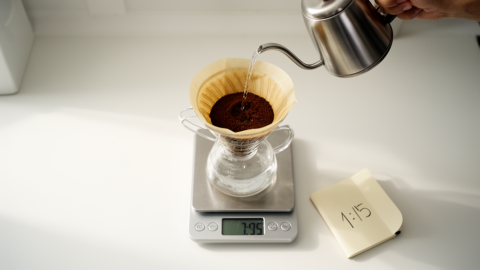
You pour 300 grams of water over 18 grams of coffee. The timer hits 2:45. You lift the dripper, pour the liquid into your favorite ceramic mug, and take a sip. It is thin. It is watery. It tastes like the coffee you made yesterday, only slightly more diluted. You reach for the grinder dial, turn it one click finer, and prepare to brew again. The problem is not the grind. The problem is the math of bypass dilution, and you are pouring water that never touches a single coffee particle directly into a cup that already holds a perfectly extracted concentrate.
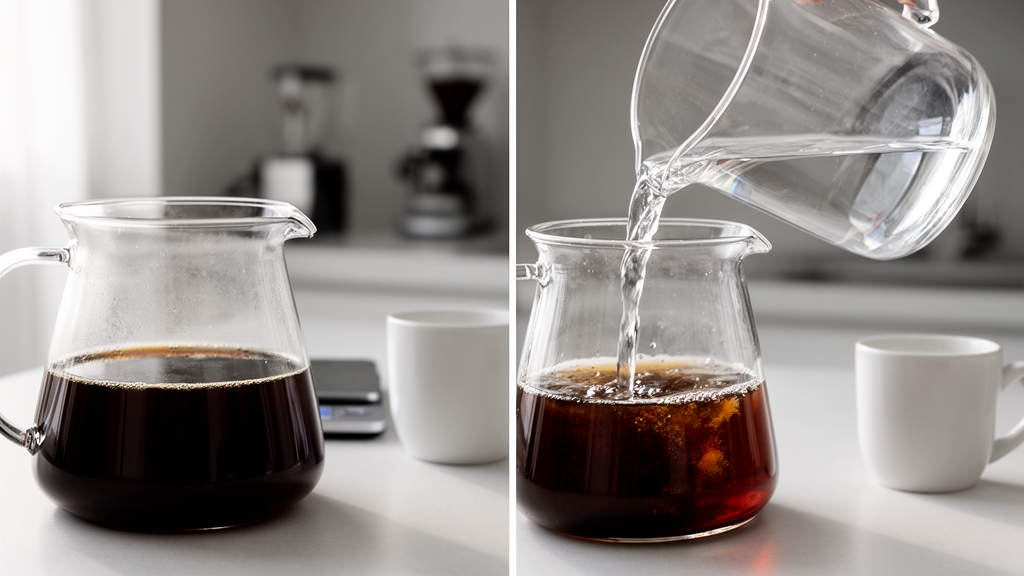
Bypass dilution is the practice of intentionally diverting a portion of your total water away from the coffee bed and adding it to the final cup after the brew has finished. It is the defining mechanic of the Hario Switch when used in pour-over mode, the standard workflow for the Fellow Ode Gen 2 with its bypass valve, and a common technique among baristas who want to control body without sacrificing clarity. But for the home brewer, bypass dilution is often the silent reason their coffee tastes weak, even when the brew ratio and grind size are technically correct.
The math is unforgiving. When you bypass 20 percent of your water, you are not making a 1:16.7 brew. You are making a 1:13.3 brew that you have artificially thinned to 1:16.7. The coffee particles in the filter are being extracted at a much higher concentration than your eyes tell you. The water sitting in your carafe or mug, the part that never touched the grounds, is pure solvent. It has zero flavor compounds, zero acidity, and zero body. It is just water. When you mix them, you are not extracting more flavor. You are diluting a highly concentrated, potentially over-extracted shot until it falls into the drinkable range.
The Concentration Trap
Let us look at the numbers. A standard 1:16 brew ratio using 18 grams of coffee and 288 grams of water produces a Total Dissolved Solids (TDS) reading of roughly 1.35 percent, assuming a 20 percent extraction yield. This is the target range for most light-roast pour-overs. Now, imagine you use a bypass valve to divert 60 grams of that 288 grams. You pour 228 grams through the coffee bed, then add the remaining 60 grams to the cup.
Your brew ratio on the scale is still 1:16. But your actual contact ratio is 1:12.6. The coffee bed is seeing 228 grams of water, not 288. The extraction yield inside the filter skyrockets because the water is working much harder to pull solubles out of the grounds. You are pushing the extraction toward the bitter, astringent end of the spectrum. The resulting concentrate might read 1.8 percent TDS, or even higher, depending on your grind and agitation.
When you mix that 1.8 percent concentrate with 60 grams of pure water, the final cup drops back down to 1.35 percent TDS. The number looks perfect on a refractometer. The taste, however, is a lie. The acidity is sharp because the soluble acids extracted rapidly in the concentrated phase. The body is thin because the heavy, viscous polymers that give coffee its mouthfeel did not have enough contact time to dissolve into the bypass water. The sweetness is muted because the larger sugar molecules require longer extraction times to fully dissolve, times you denied them by rushing the contact phase.
This is why bypass dilution often produces a ‘weak’ cup. You have traded body and sweetness for clarity and acidity, then diluted the remaining sweetness until it is barely perceptible. The math proves that you are not brewing a standard cup. You are brewing a concentrated shot and watering it down. The result is a cup that lacks the structural integrity of a properly extracted 1:16 brew.
Why Baristas Use Bypass
If the math is so punishing, why does bypass dilution exist? It exists because it solves a specific problem: body control without sacrificing clarity. In a standard pour-over, if you want more body, you grind finer. But grinding finer increases the surface area exposed to water, which pulls out more bitter compounds and astringent phenols. You get body, but you also get harshness. Bypass dilution offers a third path. You can grind coarser to keep the cup clean and bright, then use bypass water to add back some perceived weight and sweetness without touching the coffee bed.
The Hario Switch is the primary vehicle for this technique. By closing the drain valve, you create an immersion phase where all the water contacts the grounds. This allows for a very coarse grind, which naturally produces a clean, bright cup with low bitterness. Then, when you open the valve, you control the flow rate and the final dilution. It is a brilliant mechanical solution for home brewers who want espresso-like body from a pour-over without the fines that cause channeling.
However, the Switch is not the only device. Many modern grinders, like the Fellow Ode Gen 2, include a bypass valve in their dosing chambers. The idea is that you can grind a small batch, divert some grounds, and use the bypass water to adjust the final cup strength. The problem is that these systems are rarely calibrated for the home brewer’s actual extraction dynamics. They assume that all water is equal. It is not. The water that touches the grounds does the work. The bypass water just carries the result.
How to Fix a Weak Cup
If your coffee tastes thin and watery, stop turning your grinder finer. You are digging a hole that bypass dilution will only make deeper. The first step is to eliminate the bypass. If you are using a Switch, close the valve for the entire brew. If you are using a standard V60 or Kalita, stop pouring into a separate vessel and add all your water directly to the grounds. Treat every gram of water as a tool for extraction, not just a vehicle for delivery.
Once you have eliminated the bypass, you will likely find the cup tastes too strong, too bitter, or too astringent. This is the correct next step. You have removed the dilution, so the extraction has returned to its natural state. Now, adjust the grind. If the cup is bitter, grind coarser. If it is sour, grind finer. Dial in the extraction using the full brew ratio. Only after you have a balanced, full-bodied cup that tastes correct should you consider reintroducing bypass.
If you reintroduce bypass, do it with intention. Use it to add sweetness, not to fix a broken extraction. A good rule of thumb is to limit bypass to 10 percent of your total water. This is enough to soften the edges without destroying the body. Pour the bypass water slowly, in a thin stream, into the center of the cup. Do not pour it over the coffee bed. Do not let it touch the grounds. Let it do its job: dilution. If you find yourself bypassing 20 or 30 percent of your water, you are not brewing coffee. You are making a diluted concentrate. Go back to the grind.
The Trade-Off You Must Accept
Bypass dilution is not a free lunch. It is a trade-off between clarity and body, and the math always favors clarity. If you want a cup that tastes like tea, bypass is your friend. The home brewer must decide which flavor profile they are chasing. There is no objective ‘better.’ There is only the math of what you put into the filter and what you pour into the cup.
Understanding bypass dilution changes how you look at your brew. It stops being a simple ratio of water to coffee. It becomes a two-stage process: extraction, followed by dilution. The first stage determines the flavor. The second stage determines the strength. When you separate them, you gain control. But you also gain responsibility. You must understand what is happening inside the filter, because the bypass water cannot fix a bad extraction. It can only hide it. And hiding a bad extraction always tastes weak.
Sources & Further Reading
- The Coffee Roaster's Companion — BookSurge Publishing
- Bypass Dilution: A Practical Guide — Everything But Espresso