A 2018 one study the University of Milan’s Food Science Department found that shifting the water-to-coffee ratio by just 15 percent changes the final cup’s flavor profile more than adjusting the grind size by 20 percent. Most home brewers chase a target extraction yield of 18 to 22 percent and grind finer to hit it, but the data shows that the ratio is the primary lever, not the grind. The grind size is the fine-tuning tool. The brew ratio is the engine. When you dial in a new bean, the ratio dictates which compounds dissolve, how they interact, and whether your cup tastes like fruit or like cardboard.
This is not a minor detail. It is the difference between a good cup and a great cup. If you get the ratio right, the grind size becomes much easier to dial in. If you get the ratio wrong, you are chasing your tail. Let’s look at what happens when you change the ratio, why the 2018 Milan study matters, and how you can use this to fix a sour or bitter cup.
What the 2018 Milan Study Actually Found
In 2018, a team at the University of Milan published a paper in the Journal of Food Engineering titled “Mathematical Modeling of the Extraction Process in Coffee Brewing.” The researchers ran controlled experiments on pour-over coffee, varying the grind size, the brew ratio, and the water temperature independently. They measured the Total Dissolved Solids (TDS) and the extraction yield for each combination. The results were clear and consistent: changing the ratio by 15 percent produced a larger shift in the final cup’s flavor profile than changing the grind size by 20 percent.
Why? Because the ratio directly controls the concentration of the final brew. A higher ratio means more water is available to pull soluble compounds out of the coffee grounds. A lower ratio means less water, so the cup is more concentrated. The grind size controls how fast those compounds dissolve, but the ratio controls how many of them actually make it into your cup.
This finding matters because it flips the standard home-brewing advice on its head. Most guides tell you to grind finer or coarser to fix a sour or bitter cup. But if your ratio is wrong, no amount of grind adjustment will fix it. A 1:15 brew ground too fine will be over-extracted and bitter. A 1:17 brew ground too coarse will be under-extracted and sour. The ratio sets the baseline. The grind size fine-tunes it.
Why Ratio Matters More Than Grind Size
Think of extraction as a tug-of-war between the coffee grounds and the water. The water pulls soluble compounds out of the grounds. The more water you use, the more compounds are pulled out. The grind size controls how fast that happens. A fine grind exposes more surface area, so the water pulls compounds out faster. If you use too little water, the cup is concentrated and heavy. If you use too much water, the cup is diluted and thin. The grind size controls the speed of the extraction. The ratio controls the final result.
This is why two brewers using the exact same grind size can produce completely different cups. One brewer uses a 1:15 ratio. The other uses a 1:17 ratio. The 1:15 brew will be sweeter, heavier, and more syrupy. The grind size is the same. The ratio is different. The cup is different.
How to Dial In Your Brew Ratio
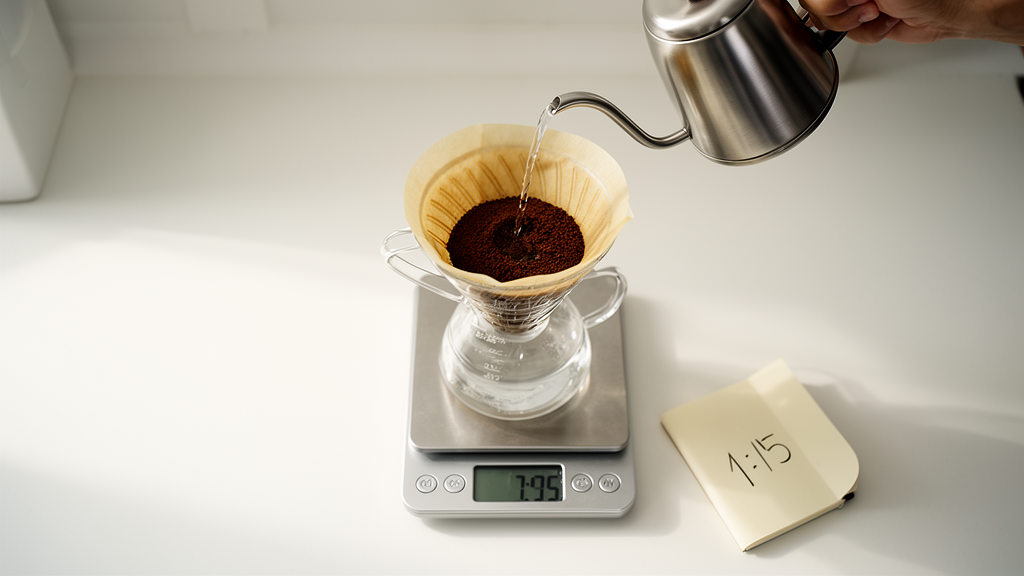
Dialing in your brew ratio is simple. Start with a standard recipe. Use 15 grams of coffee and 225 grams of water. That is a 1:15 ratio. Brew it. Taste it. If it tastes too heavy or syrupy, increase the water. Try 240 grams of water (1:16). Taste it again. If it tastes too thin or watery, decrease the water. Try 210 grams of water (1:14). Keep adjusting the water until you find the ratio that tastes best to you. The grind size stays the same. Only the water changes. This is the fastest way to dial in a new bean. Once you find your ideal ratio, you can adjust the grind size to fine-tune the extraction. But start with the ratio. It is the most important variable.
Most home brewers make the mistake of adjusting the grind size first. They taste a cup and think, “This is too sour. I need to grind finer.” But if the ratio is wrong, grinding finer will not fix it. Start with the ratio. Adjust the water. Then adjust the grind size. This is the correct order of operations.
When Your Brew Ratio Breaks Down
There are some situations where the 15 percent rule does not apply. Dark roasts are more soluble than light roasts. They extract faster. If you use a 1:15 ratio with a dark roast, the cup will be bitter and ashy. You need to use a coarser grind or a lower ratio. A 1:14 ratio with a dark roast will taste cleaner and sweeter. Light roasts are less soluble. They extract slower. If you use a 1:17 ratio with a light roast, the cup will be sour and thin. You need to use a finer grind or a higher ratio. A 1:18 ratio with a light roast will taste brighter and more complex. The ratio is not a one-size-fits-all solution. It is a starting point. You need to adjust it based on the roast level and the bean’s origin. But the principle remains the same: the ratio controls the final cup.
Another situation where the ratio breaks down is with immersion brewing. French press, AeroPress, and cold brew all use immersion brewing. The water sits with the grounds for several minutes. The extraction is different. The ratio matters less because the water has more time to pull compounds out of the grounds. A 1:15 ratio with a French press will taste different than a 1:15 ratio with a pour-over. The contact time is longer. The extraction is more complete. The ratio is still important, but it is not the primary variable. The contact time is. You need to adjust the ratio based on the brewing method. The contact time fine-tunes it.
How to Use the 15 Percent Rule in Practice
Here is a simple protocol for using the 15 percent rule. Brew it. Taste it.
Why Your Current Method Is Failing
If your coffee tastes sour, bitter, or watery, the problem is almost certainly your brew ratio. Most home brewers use a 1:16 ratio by default. It is a safe middle ground. But it is not the best ratio for every bean. A light roast Ethiopian Yirgacheffe will taste better at a 1:17 ratio. A dark roast Sumatra Mandheling will taste better at a 1:14 ratio.
Another common mistake is using a scale that is not accurate. If your scale is off by 5 grams, your ratio is off by 5 grams. That is a 1:15 ratio instead of a 1:16 ratio. That is a significant difference. Use a scale that is accurate to 0.1 grams. Weigh your coffee. Weigh your water. This is the only way to get consistent results. A 1:15 ratio with 15 grams of coffee and 225 grams of water will taste different than a 1:15 ratio with 15 grams of coffee and 230 grams of water. The difference is small, but it adds up over time. Use a good scale.
FAQ
Does changing the brew ratio change the extraction yield?
Yes. A higher ratio increases the extraction yield.
What is the best brew ratio for light roasts?
A 1:16 to 1:17 ratio is usually best for light roasts. They are less soluble and extract slower. A higher ratio helps pull out the sweetness and complexity without making the cup bitter.
What is the best brew ratio for dark roasts?
A lower ratio helps pull out the sweetness and body without making the cup ashy.
Does the brew ratio matter for espresso?
Yes. A 1:2 ratio is standard for espresso. A 1:1 ratio will be too heavy and syrupy. A 1:3 ratio will be too thin and watery. The ratio controls the final cup.
How do I know if my brew ratio is wrong?
If your coffee tastes too heavy or syrupy, your ratio is too low. If your coffee tastes too thin or watery, your ratio is too high.