Stop grinding finer to fix bitterness. You are chasing a symptom that has nothing to do with the actual extraction process. The reason your coffee tastes harsh, astringent, or like burnt wood is almost never because you pulled too much out of the bean. It is because you concentrated too much of what you pulled into the cup. The problem is not extraction; it is concentration.
When you brew coffee, you are running a chemical extraction process. Water dissolves soluble compounds from the ground bean at different rates. Acids dissolve first, followed by sugars, and finally by bitter alkaloids and heavy phenols. This sequence is real, measurable, and documented. But the bitterness you taste in your cup is not a direct measure of how much of those bitter compounds you pulled. It is a measure of how much of everything you pulled is packed into every milliliter of liquid.
Most home brewers are taught a simple, intuitive rule: if the coffee tastes bitter, you extracted too much, so grind finer next time. This advice is fundamentally flawed because it ignores the role of concentration. You can have a perfectly balanced extraction that tastes bitter simply because you brewed it too strong. You can have a severely under-extracted cup that tastes pleasant simply because you diluted it enough. The flavor you taste is a function of two independent variables: extraction yield and dissolved solids concentration. Treating them as the same variable is why your troubleshooting never works.
What Extraction Yield Actually Means
Extraction yield is a percentage. It tells you what fraction of the total dry mass of your ground coffee ended up inside your cup. If you start with 15 grams of coffee and end up with 225 grams of liquid containing 3.6 grams of dissolved solids, your extraction yield is 24 percent. The Specialty Coffee Association defines the ideal extraction yield range for a balanced, pleasant cup as 18 to 22 percent. This is a widely accepted standard, though it varies slightly by roast level and origin.
When you grind finer, you increase the surface area of the coffee particles. This allows water to dissolve soluble compounds faster, which increases your extraction yield. If your coffee tastes sour, it means your extraction yield is too low, likely below 18 percent. You haven’t pulled enough sugar or enough acid out of the bean. Grinding finer is the correct response to sourness. It pushes your yield into the ideal range.
But when your coffee tastes bitter, grinding finer pushes your extraction yield higher, past 22 percent, and into the over-extraction zone. This pulls more of the heavy, bitter phenols and alkaloids into your cup. This is the textbook explanation. It is also only half the story. It completely ignores the concentration of those compounds in the final liquid.
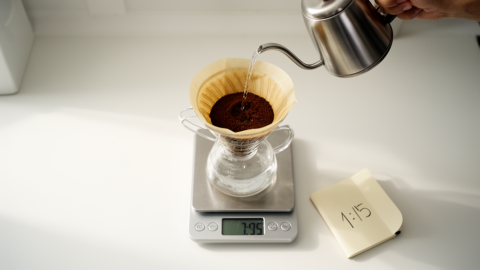
Consider two cups. Cup A is brewed at a 1:15 ratio, meaning 15 grams of coffee to 225 grams of water. Both cups are brewed to the exact same extraction yield of 20 percent. The coffee in Cup A will taste significantly stronger, more intense, and potentially more bitter than the coffee in Cup B. Why? Because Cup A has more dissolved solids per milliliter. The bitter compounds are more concentrated. The water-to-coffee ratio acts as a dilution factor, masking or amplifying the flavors you extracted.
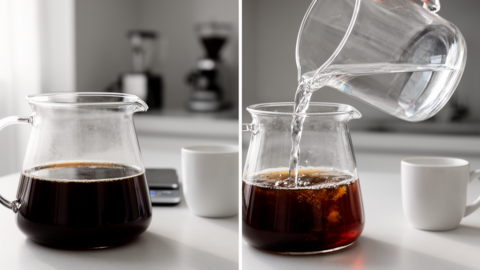
This is why your “over-extracted” coffee might actually be perfectly extracted but simply too strong for your palate. You can fix the bitterness by grinding coarser, which lowers the extraction yield, or by adding more water, which lowers the concentration. The first method changes the chemistry of the extraction. The second method changes the physics of the final liquid. Both work, but they work for completely different reasons.
How Concentration Masks Under-Extraction
The reverse is equally true. If you use a 1:25 ratio with a very coarse grind, your extraction yield might be only 14 percent. You have pulled very little sugar and very few bitter compounds. The result is a thin, watery cup that might taste sour, but it will also taste light and clean. The lack of heavy bitter compounds makes the sourness less offensive. This is why some light-roast, high-acidity coffees are brewed with very high water-to-coffee ratios. The goal is not to maximize extraction yield. The goal is to balance the acidity by diluting the concentration of dissolved solids.
This is the core mistake home brewers make when they try to fix bitterness. They assume that bitterness always equals over-extraction. They respond by grinding finer, which increases the extraction yield, pulling even more bitter compounds into the cup. If the coffee was already too strong, this makes the bitterness worse. The correct response is to increase the water-to-coffee ratio, diluting the concentration of everything you already pulled. This lowers the perceived bitterness without changing the extraction yield.
Think of it like making tea. If you steep a bag of tea for five minutes, it becomes incredibly bitter and astringent. The standard advice is to stop steeping it sooner. But what if you already have that five-minute cup in front of you? You can’t un-steep the tea. You can add hot water to it. The tea becomes less bitter, less intense, and more drinkable, even though the extraction yield remains exactly the same. You have changed the concentration, not the extraction. Coffee works the exact same way.
Why Your Troubleshooting Fails
When you follow standard troubleshooting guides, you are given a binary choice: grind finer for sour, grind coarser for bitter. This binary assumes that extraction yield is the only variable that matters. It assumes that your water-to-coffee ratio is fixed and non-negotiable. This assumption is false. Your water-to-coffee ratio is a primary dial, just like your grind size. It controls concentration, and concentration controls flavor perception.
If you are brewing at a 1:16 ratio and your coffee tastes bitter, grinding finer will increase your extraction yield, pulling more bitter compounds into the cup. This will make the bitterness worse. The correct response is to grind coarser, which lowers the extraction yield, and then increase the water-to-coffee ratio to maintain the same concentration. This keeps the strength of the cup the same while reducing the amount of bitter compounds extracted. This is the missing step in almost every troubleshooting guide.
This will make the coffee taste sweeter and less sour. This is the correct response. But you can also achieve a sweeter cup by grinding coarser and using a lower water-to-coffee ratio. This increases the concentration of the sugars you did pull, making the sweetness more intense. This is a more advanced technique, used by competition baristas to highlight specific flavor notes in light-roast coffees.
The key insight is that extraction yield and concentration are independent variables. You can achieve the same flavor profile with different combinations of grind size and water-to-coffee ratio. A 1:15 ratio at 20 percent extraction yield tastes different from a 1:18 ratio at 20 percent extraction yield. Understanding this independence is the difference between guessing and dialing in.
How to Fix Bitterness Without Grinding Finer
So, what do you do when your coffee tastes bitter? The first step is to stop grinding finer. If you grind finer, you increase the extraction yield, pulling more bitter compounds into the cup. The correct response is to increase the water-to-coffee ratio. Add more water to your cup. This dilutes the concentration of all dissolved solids, including the bitter ones. The coffee will taste less intense, less bitter, and more balanced. This is the fastest way to fix bitterness without changing your grind setting.
If you want to maintain the same strength while reducing the bitterness, you need to change both variables. Grind coarser to lower the extraction yield, pulling fewer bitter compounds. Then, increase the water-to-coffee ratio to maintain the same concentration. This is the most precise way to fix bitterness. It requires you to understand the relationship between grind size, water-to-coffee ratio, and extraction yield.
Start by brewing a batch of coffee at your standard ratio, say 1:16. Taste it. If it tastes bitter, note the intensity. Brew another batch at a 1:18 ratio, using the exact same grind size. Taste it. You will find the second batch tastes less intense, less bitter, and more balanced. This is the power of concentration. You have not changed the extraction yield. You have changed the concentration of the dissolved solids. This is the missing link in your troubleshooting.
Once you understand this, you can start to dial in your coffee with precision. If your coffee tastes bitter, increase the water-to-coffee ratio. This is the foundation of precise coffee brewing. It is simple, it is effective, and it is ignored by almost every guide on the internet.
When Extraction Yield Actually Matters
There are times when extraction yield is the primary variable that matters. If you are brewing a very dark roast, the bean structure is more porous, and the soluble compounds are more accessible. This means you can achieve a high extraction yield with a coarse grind. The risk is that you will pull too many bitter compounds, resulting in a harsh, ashy cup. In this case, grinding finer is the correct response to sourness, but you must be careful not to over-extract. The goal is to balance the extraction yield with the concentration of dissolved solids.
This means you need a finer grind to achieve a high extraction yield. The risk is that you will pull too many acids, resulting in a sour, sharp cup.
The key is to understand that extraction yield and concentration are two sides of the same coin. You cannot change one without affecting the other. The goal is to find the sweet spot where the extraction yield is high enough to pull out the sugars and acids, but low enough to avoid pulling out the bitter compounds. The concentration of dissolved solids determines how strong or weak that balance tastes. Understanding this relationship is the key to brewing better coffee.
FAQ
Does adding water to bitter coffee actually fix it?
Yes. This makes the coffee taste less intense and less bitter, even though the extraction yield remains the same. It is a physical dilution, not a chemical change.
Why do some guides tell me to grind finer for bitterness?
Those guides are simplifying the problem. They assume that your water-to-coffee ratio is fixed. If you cannot change your ratio, grinding finer is the only way to change the flavor. But it is rarely the best way. Changing your ratio is almost always more effective.
What is the ideal water-to-coffee ratio for home brewing?
There is no single ideal ratio. It depends on your taste preferences and the coffee you are brewing. A 1:15 ratio is strong and intense. A 1:18 ratio is lighter and more balanced. Start with 1:16 and adjust from there. Taste, adjust, repeat.
Can I use a refractometer to measure concentration?
Yes. A refractometer measures Total Dissolved Solids (TDS), which is a direct measure of concentration. It does not measure extraction yield. To measure extraction yield, you need to know the mass of dry coffee and the mass of dissolved solids. This is a more advanced technique, but it is the most precise way to dial in your coffee.
Sources & Further Reading
- Specialty Coffee Association (SCA) Brewing Standards — Specialty Coffee Association
- The Coffee Brewing Handbook: A Practical Guide to Making Great Coffee — Specialty Coffee Association
- Sensory Evaluation of Coffee: A Practical Handbook — Specialty Coffee Association
Photo by Nathan Dumlao on Unsplash.