The Preheat Myth: Why Your Kettle Is Warming the Dripper, Not the Coffee
Everyone tells you to preheat your dripper. You pour hot water into the cone, let it sit for thirty seconds, dump it out, and then add your grounds. It feels like a ritual. It feels like the difference between a home brewer and a serious one. But what if the reason you are doing it is entirely wrong? What if the thermal mass of your ceramic or glass dripper is so low that it stops mattering after the first pour, and the only thing you are actually achieving is wasting water and delaying your brew time?
The answer lies in the physics of heat transfer, specifically the difference between thermal mass and thermal conductivity. Preheating matters, but not for the reason you think, and not on every piece of equipment. For most home brewers using standard glass or thin ceramic drippers, preheating is a negligible variable. For brewers using thick stoneware, metal, or insulated chambers, it is a critical control. The real variable you are ignoring is the temperature of the water hitting the grounds, and that is controlled by your kettle, not your dripper.
Thermal Mass vs. Thermal Conductivity
To understand why you should preheat your dripper (or skip it), you have to look at the material properties of your gear. Every object has a specific heat capacity, which is the amount of energy required to raise its temperature by one degree. Glass has a relatively low specific heat capacity. Ceramic, especially thin porcelain, is similar. Metal, on the other hand, has a much higher thermal conductivity, meaning it transfers heat from the water to the walls of the dripper almost instantly.
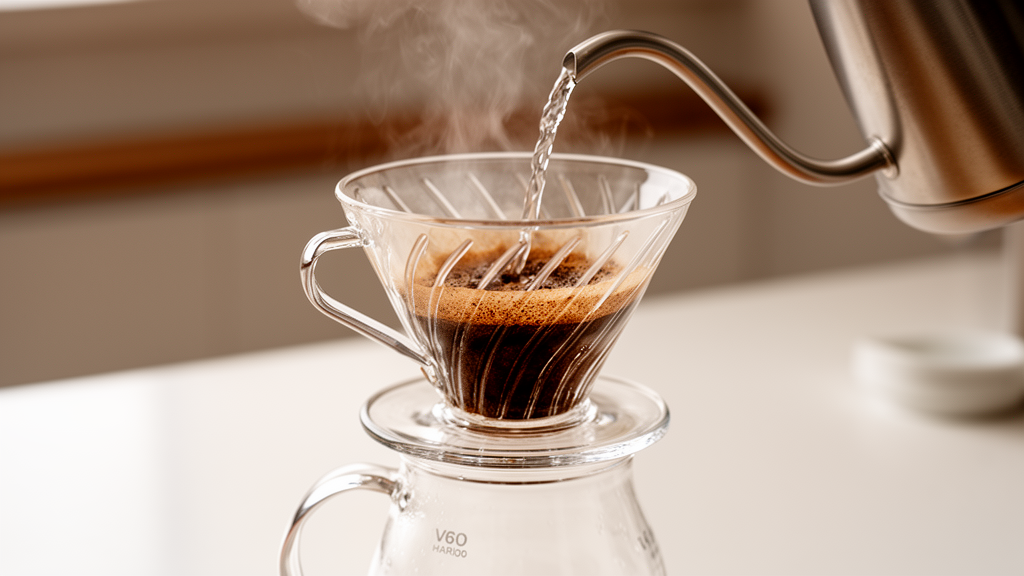
When you pour 93°C water into a cold Hario V60 glass dripper, the glass absorbs a small amount of heat. It warms up quickly, but because it has low thermal mass, it doesn’t hold much energy. The water temperature drops by maybe 2 to 3 degrees Celsius. When you dump the water and add your coffee, the dripper is now close to brewing temperature. The next pour of water stays hot enough to extract the coffee properly.
Now, imagine you are using a thick, heavy ceramic Kalita Wave or a metal dripper like the Fellow Ode or a stainless steel cone. These materials have higher thermal mass. If you do not preheat them, they will act as a heat sink, pulling energy out of your brewing water rapidly. The water hitting the grounds will be significantly cooler than what came out of your kettle. This is not a myth. It is basic thermodynamics. The dripper absorbs the heat, the water cools, and your extraction yield drops because you are brewing with cooler water than you intended.
So, preheating is not a myth. It is a necessary step for high-mass drippers. But for low-mass glass and thin ceramic, the benefit is marginal. The water temperature drop is so small that it falls within the margin of error for your kettle’s accuracy. If your kettle says 93°C but is actually 90°C, preheating the dripper will not fix that. You are optimizing for a variable that is already negligible, while ignoring the larger source of error.
The Real Variable: Water Temperature at Contact
The most important number in pour-over brewing is not the temperature of the water in your kettle. It is the temperature of the water the moment it touches the coffee grounds. This is where the preheat ritual often fails to deliver value. If you pour hot water into a cold dripper, wait thirty seconds, dump it, and then add your coffee, you have already lost heat. The dripper, the server, and the air above the brew are all cooling your water before a single gram of coffee is extracted.
A one study the Specialty Coffee Association on extraction variables highlights that water temperature is the primary driver of extraction rate. But they also note that the temperature must be stable throughout the brew. If your dripper is cold, the first few seconds of your bloom will cool the water significantly. If your dripper is preheated, the water stays hot. The difference is not in the total energy, but in the consistency of the extraction profile.
For most home brewers, the difference between a preheated and unpreheated glass dripper is less than 1°C in the final cup. That is within the range of taste variation caused by grind size inconsistency. If you are grinding your coffee, the particle distribution is likely causing more extraction variance than the temperature of your dripper. Focusing on preheating is like polishing the hubcaps while the engine is overheating. It feels productive, but it does not solve the core problem.
When Preheating Actually Matters
There are specific scenarios where preheating is non-negotiable. If you are brewing with a thick stoneware dripper, a metal cone, or an insulated server, you must preheat. These materials have high thermal mass. They will absorb heat from your brewing water, lowering the extraction temperature and potentially leading to a sour, under-extracted cup. In these cases, preheating is not a ritual. It is a requirement for consistency.
Similarly, if you are brewing in a cold environment, such as a drafty kitchen in winter, the ambient temperature can cool your water faster. Preheating the dripper helps maintain the temperature gradient between the water and the surrounding air. It is a small buffer, but a useful one. If you are brewing multiple cups in succession, the dripper will cool down between brews. Preheating each brew ensures that the first pour of each cycle starts at the correct temperature.
For the vast majority of home brewers using glass or thin ceramic drippers, however, preheating is a waste of time and water. The thermal mass is too low to make a significant difference. The water temperature drop is negligible. The ritual is comforting, but it does not improve the cup. If you want to improve your pour-over, focus on your grind size, your brew ratio, and your pour technique. These variables have a much larger impact on extraction than the temperature of your dripper.
The Cost of the Ritual
Preheating costs time. It costs water. It costs attention. Every time you preheat, you are adding thirty seconds to your brew cycle. If you are brewing multiple cups, that time adds up. More importantly, it distracts you from the variables that actually matter. While you are waiting for the dripper to heat up, you are not paying attention to your bloom, your pour rate, or your total brew time. These are the variables that control extraction. Preheating is a distraction from the craft.
There is also an environmental cost. Pouring hot water down the drain is wasteful. If you are preheating every brew, you are wasting liters of water every week. This is not a major issue for most households, but it is a habit that reinforces the idea that preheating is necessary. It is not. It is a ritual that has been passed down from barista culture to home brewing without a scientific basis. It is time to question it.
What You Should Do Instead
If you want to improve your pour-over, stop preheating your dripper. Instead, focus on your water temperature. Use a kettle with a built-in thermometer, or invest in a separate thermometer. Know the exact temperature of your water before you pour. If your water is too cool, your coffee will be sour. If it is too hot, your coffee will be bitter. This is the variable you can control. Preheating your dripper does not give you control over this. It only gives you a false sense of security.
Focus on your grind size. This is the most important variable in pour-over brewing. If your grind is too fine, your coffee will be bitter and over-extracted. If it is too coarse, your coffee will be sour and under-extracted. Dialing in your grind size is the single most effective way to improve your cup. Preheating your dripper will not fix a bad grind. It will not fix a bad ratio. It will not fix a bad pour. It is a ritual that has outlived its usefulness.
Finally, focus on your pour technique. The way you pour water over your grounds controls the extraction rate. A slow, circular pour ensures even saturation. A fast, direct pour can channel the water and lead to uneven extraction. These are the variables that determine the flavor of your cup. Preheating your dripper does not affect these variables. It is a distraction from the craft. It is time to let it go.
The Verdict
Preheating your dripper is not a myth. It is a real physical phenomenon. But for most home brewers, it is a negligible one. The thermal mass of your glass or thin ceramic dripper is too low to make a significant difference. The water temperature drop is small. Let the ritual go. Brew your coffee. Taste the difference.