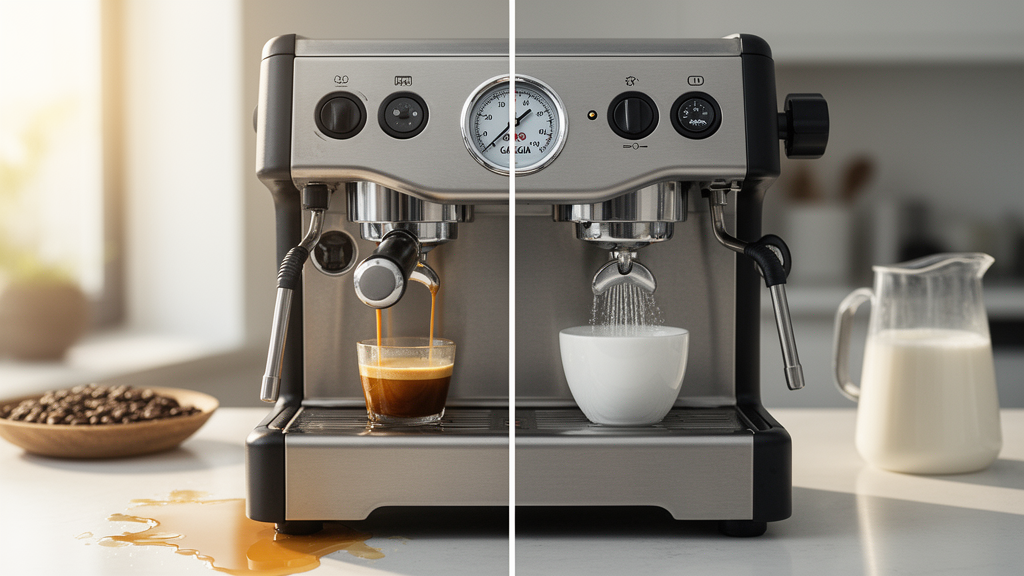
The portafilter is locked in. The group head is hot. You pull a 25-second shot, the crema is thick and tiger-striped, and you immediately flip the three-way valve to switch to steam. The pressure gauge drops. The steam wand hisses weakly, spitting cold water for ten seconds before finally delivering anything resembling microfoam. By the time the milk is ready, the espresso has cooled by four degrees and the crema has begun to collapse. This is the single boiler bottleneck, and it is the single most frustrating mechanical limitation on the Gaggia Classic Pro.
That frustration is not a user error. It is a thermodynamic consequence of a single heating element doing two mutually exclusive jobs. Brewing espresso requires water at 93°C (199°F). Steaming milk requires water at 100°C (212°F), plus enough thermal mass to maintain that temperature while a steam wand vents hundreds of kilopascals of pressure. A single boiler cannot hold both temperatures at once. The machine must choose, and it chooses steam every time, leaving your espresso to suffer the thermal lag.
The Thermodynamics of a Single Heating Element
To understand why this happens, you have to look at the hardware. The Gaggia Classic Pro uses a single 1300-watt aluminum boiler. This same element heats the water for the brew group and the water for the steam wand. There is no heat exchanger. There is no dual boiler. There is just one tank of water, one metal block, and one electrical circuit.
When you pull a shot, the machine maintains the water at a precise brewing temperature. This is controlled by a thermostat that cycles the element on and off to keep the boiler within a narrow window, usually around 90°C to 93°C. This is perfect for extraction. It allows the soluble compounds in the coffee to dissolve at a controlled rate, balancing acidity and sweetness.
When you flip the switch to steam, the machine’s logic changes entirely. The thermostat is bypassed. The element goes full power, 1300 watts, with no upper limit, until the boiler pressure reaches the maximum cut-off, usually around 1.0 to 1.2 bar. At this point, the water is boiling. The steam generated is dry, superheated, and incredibly hot. This is exactly what you need to stretch and texturize milk.
The problem is the transition. To go from brewing to steaming, you must wait. The machine needs time to raise the water temperature from 93°C to 100°C. On a cold start, this takes three to four minutes. On a warm machine, it takes sixty to ninety seconds. During this time, you cannot pull a shot. If you try, the water coming out of the group head will be under 90°C, pulling a sour, under-extracted shot that tastes sharp and thin.
The Thermal Lag That Ruins Workflow
For a home barista making one cup of espresso, this thermal lag is an annoyance. You wait a minute. You steam your milk. You drink your coffee. The workflow is slow, but it is manageable. The real friction appears when you are making multiple drinks, or when you are trying to maintain a consistent rhythm during a morning rush.
Let’s say you pull two shots back-to-back. The first shot is perfect. You lock in the second portafilter, and you realize you need to steam milk for a latte. You flip the valve. The pressure gauge drops to zero. The water in the group head cools rapidly because the element is now dedicated to boiling the entire boiler volume. You wait. You steam. You pour.
Now you want to pull a third shot. The boiler is full of boiling water. If you pull immediately, you will scald the coffee. The water will be well past 100°C, extracting bitter, astringent compounds that taste like burnt rubber and ash. You have to wait again. You have to let the boiler cool down from 100°C back to 93°C. This cooling period can take another two minutes. You are now waiting five minutes total between shots, not because of extraction time, but because of thermodynamics.
This is the bottleneck. It is not a design flaw in the sense that the machine is broken. It is a design choice that prioritizes cost and simplicity over performance. The Gaggia Classic Pro is an entry-level machine. It is affordable. It is durable. But it is mechanically incapable of simultaneous brewing and steaming. Any machine with a single boiler shares this limitation. The Rancilio Silvia, the Breville Barista Express, the De’Longhi Dedica. They all share this fundamental constraint.
Workarounds That Actually Work
Knowing the limitation is half the battle. The other half is managing it. There are three practical strategies to mitigate the single boiler bottleneck, each with its own trade-offs.
1. The Two-Cup Workflow
This is the most common approach. You pull all your shots first. You lock in the portafilters, flush the group head, and pull two shots into your cups. You set them aside. Then, you flip the valve to steam. You pour. This works perfectly for two drinks. It breaks down when you need three or four. The first shot will cool down significantly while you steam the second milk. The crema will degrade. The flavor will flatten. For a home user making one or two drinks, this is acceptable. For a household of three, it is a bottleneck.
2. The Flush and Wait
Some baristas try to pull a shot, then immediately flush the group head to cool it down before steaming. This is inefficient. You are wasting water, wasting coffee, and still waiting for the boiler to reach steam pressure. It adds steps without solving the core thermodynamic issue. Avoid this unless you are cleaning the group head gasket, which is a separate maintenance task.
3. The Heat Exchange Hack
This is a more advanced modification. Some users install a heat exchange kit, such as those from Espresso Mods. This involves replacing the stock boiler with a copper tube that runs through the main boiler. You run hot water from the main boiler through the copper tube to heat the brew water. This allows you to maintain steam pressure while keeping the brew water at a lower temperature. It is expensive, it requires significant mechanical skill, and it voids your warranty. For most users, it is not worth the investment. The single boiler workflow is sufficient if you accept the pace it demands.
Why This Matters for Your Cup
The single boiler bottleneck is not just about waiting. It is about the quality of the espresso. When you pull a shot after steaming, the boiler may still be too hot. The water temperature may be 98°C instead of 93°C. This five-degree difference changes the extraction profile. It extracts more bitter compounds. It makes the coffee taste harsher. It masks the subtle fruit notes you paid extra for.
Conversely, if you pull a shot before the boiler has fully heated to steam temperature, the water may be too cool. The extraction will be underdeveloped. The acidity will be sharp and unbalanced. The body will be thin. You are left with a choice: bitter or sour. Neither is ideal.
This is why understanding your machine’s limitations is critical. You cannot force a single boiler to behave like a dual boiler. You must work with its rhythm. You must plan your workflow around the thermodynamics. You must accept that making multiple drinks takes longer. And you must accept that the quality of the espresso will suffer if you rush the process.
Is It Worth Upgrading?
If you are making one or two drinks per day, the Gaggia Classic Pro is a fantastic machine. It is robust. It is repairable. It uses standard parts. The single boiler bottleneck is a minor inconvenience. But if you are making four or five drinks, or if you value speed and consistency above all else, you will hit this wall repeatedly. The solution is not a better grinder. It is a machine with two boilers, or a heat exchange system.
The Gaggia Classic Pro is not a bad machine. It is an honest machine. It tells you exactly what it can do. It cannot brew and steam at the same time. It will never be able to. The question is whether you can work within those limits. If you can, it will serve you well. If you cannot, it will frustrate you every single morning.
Frequently Asked Questions
How long does it take to switch from brew to steam on a Gaggia Classic?
On a cold start, expect three to four minutes. This is the time required to raise the water temperature from 93°C to 100°C.
Can I pull a shot while steaming?
No. The single heating element cannot maintain two different temperatures simultaneously. If you try, the water will be either too hot (scalding the coffee) or too cool (under-extracting it).
Does the Gaggia Classic Pro have a heat exchanger?
No. It has a single aluminum boiler. This is the source of the single boiler bottleneck. Machines with heat exchangers, like the La Marzocco Linea, use a copper tube inside the boiler to allow simultaneous brewing and steaming.
Is the single boiler bottleneck a dealbreaker?
For single or double drinks, no. For large batches, yes. It slows your workflow and compromises the quality of back-to-back shots. Consider a dual boiler machine if speed and consistency are your priorities.
Can I modify my Gaggia Classic Pro to fix this?
Yes, through a heat exchange kit. However, these kits are expensive, complex to install, and void your warranty. For most users, the cost and effort outweigh the benefits.