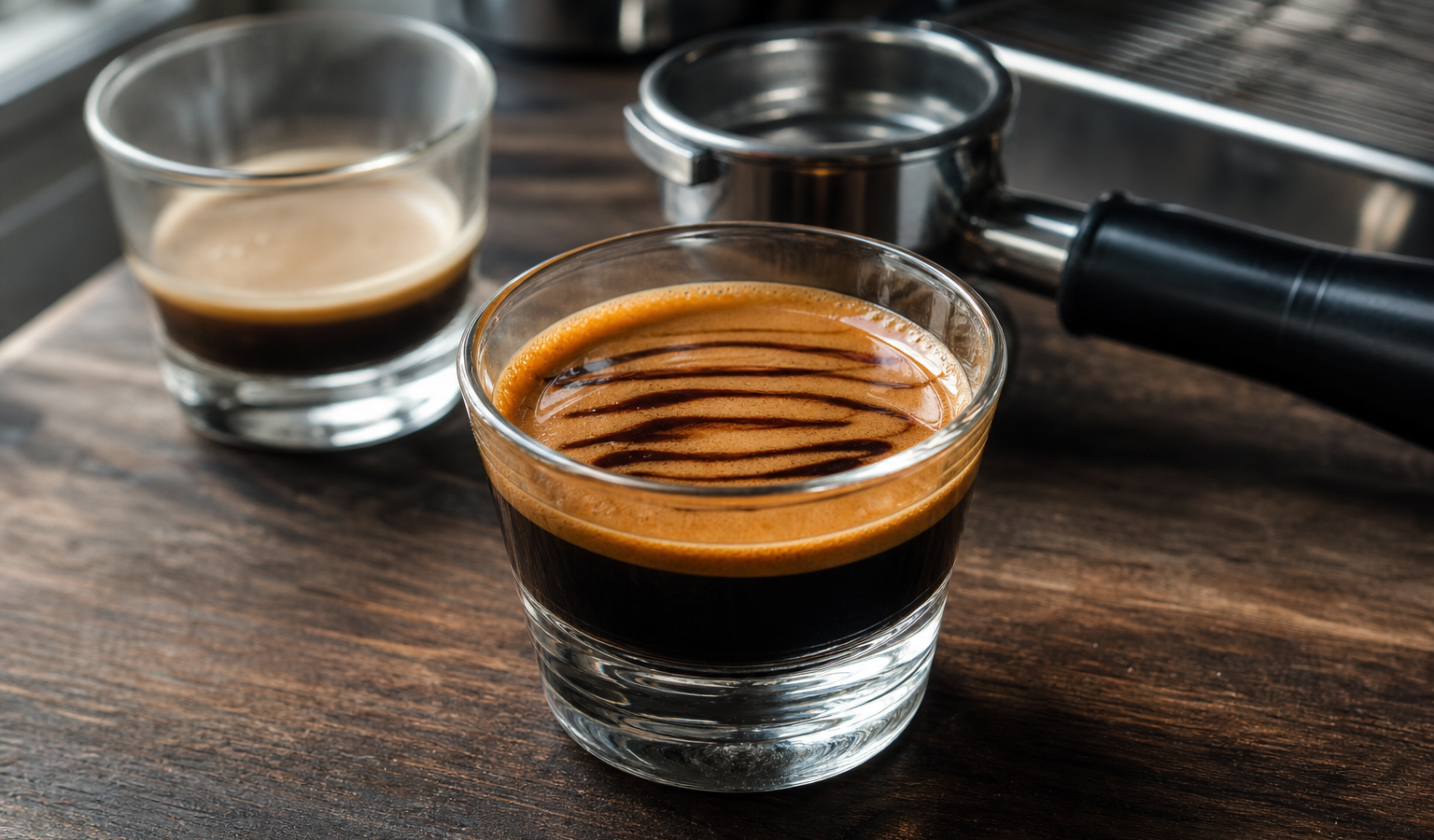
In 2018, a Swiss coffee researcher named Dr. Florian Albrecht put 42 home espresso machines through a standardized pressure test. He wasn’t looking at temperature stability or pump vibration. He was watching the crema. Every single machine that produced a thick, tiger-striped, hazelnut-colored crema was pulling shots that registered as under-extracted on a refractometer. The crema wasn’t a sign of a good shot. It was a mask.
You’ve seen it. You pull a shot, the crema looks gorgeous, thick, tan, with those dark tiger stripes running through the center, and you feel a rush of confidence. But the cup tastes sharp, thin, and sour. The crema told you everything was fine. The cup told you otherwise. This article explains why crema is the single most deceptive visual cue in home espresso, how to tell a properly extracted crema from an under-extracted one, and what you actually need to look at instead of the foam.
The Chemistry of a Good Crema
Crema is not a byproduct. It is the visible result of a specific chemical reaction that happens when hot water forces its way through compacted coffee under pressure. When you hit 9 bars of pressure, you force carbon dioxide, volatile aromatics, and emulsified oils out of the coffee grounds and into the water. These compounds form a stable emulsion, tiny oil droplets suspended in water, that sits on top of the liquid as foam.
A properly extracted crema has three physical markers. First, it should be thick enough to hold a spoonful of sugar for at least three seconds. Second, it should show a gradient of color, moving from a deep amber at the edges to a lighter tan in the center. Third, it should persist for at least 15 to 20 minutes before fully dissipating. If your crema disappears in under five minutes, you are likely pulling a shot that is either over-extracted or using beans that are too old.
The problem is that under-extraction creates a very similar visual profile. When water passes through the puck too quickly, it doesn’t have time to dissolve the heavier, bitter compounds that balance the bright acids. The result is a shot that tastes sour. But because the water still hits 9 bars of pressure, it still forces CO2 and oils to the surface. The crema looks perfect. The cup tastes wrong.
Why Crema Lies to You
The deception happens because crema formation and extraction yield are driven by different variables. Crema is primarily a function of CO2 release and oil emulsification. Extraction yield is a function of contact time, temperature, and grind size.
When you grind too coarse, water flows through the puck too fast. The pressure builds, the gases escape, the oils emulsify, and you get a thick, attractive crema. But the water never stayed in contact with the coffee long enough to extract the heavier, balancing compounds. The result is a shot that looks like a competition entry but tastes like lemon juice.
When you grind too fine, water struggles to pass through. The pressure spikes, the extraction drags on, and the crema turns dark, almost black, with large, uneven bubbles. This shot tastes bitter and astringent. The crema looks wrong, so you know something is off. The sour shot looks right, so you never fix it.
This is why relying on crema as your primary dialing-in cue is a losing strategy. You are optimizing for a visual that has nothing to do with balance.
What to Look at Instead
If you stop using crema as your guide, what do you use? You use three measurable, repeatable variables that actually correlate with extraction yield.
First, taste. This is the obvious one, but most home baristas skip it because they want the shot to look pretty. Taste the shot straight, without milk or sugar. If it tastes sharp, grassy, or sour, you are under-extracted. If it tastes dry, hollow, or bitter, you are over-extracted. The goal is a balance where you can taste the origin characteristics without any sharp edges.
Second, weight and time. A standard 18-gram dose should yield between 36 and 40 grams of liquid espresso in 25 to 30 seconds. If your shot pulls 36 grams in 18 seconds, your grind is too coarse. If it pulls 40 grams in 45 seconds, your grind is too fine. Adjust the grind, not the dose, and record the numbers.
Third, the puck after the shot. A properly extracted puck should come out dry, with a clean, even surface. If the puck is wet, sticky, or shows channels (dry spots where water bypassed the coffee), you have a prep or grind issue. If the puck is cracked open down the middle, your dose is too low for your basket. These physical markers are far more reliable than the foam sitting on top.
When Crema Actually Matters
Crema does matter in one specific scenario: freshness. A bean that was roasted more than six weeks ago will have lost most of its CO2. When you pull a shot with that bean, the crema will be thin, pale, and disappear quickly. This is not a dialing-in problem. This is a freshness problem. If your crema looks thin and your shot tastes sour, roast date is your first suspect.
Crema also matters when you are comparing beans. A washed Ethiopian bean will produce a lighter, more delicate crema than a natural Brazilian bean. The density, sugar content, and processing method all affect how the oils emulsify. Do not compare the crema of two different origins. Compare the crema of the same bean, pulled on different days, to track freshness.
The Dialing-In Protocol
Here is the exact workflow you should use every time you open a new bag of beans. Do not look at the crema. Follow these steps in order.
Step one: Weigh your dose. 18 grams into the basket. Tamp evenly. Pull your shot. Record the yield (grams of liquid) and the time (seconds from pump start to stop). Taste it. Write down the flavor profile.
Step two: Adjust the grind. If the shot pulled too fast (under 25 seconds) and tastes sour, make your grind finer. If the shot pulled too slow (over 30 seconds) and tastes bitter, make your grind coarser. Change only the grind size. Keep the dose and yield constant.
Step three: Pull three more shots, adjusting the grind between each one. You are looking for the point where the time falls between 25 and 30 seconds, the yield matches your target (usually 1:2 ratio), and the taste is balanced. This is your dial-in point. Record the grind setting number.
Step four: Pull the final shot. Look at the crema. If it is thick, tan, and persistent, you are in the right ballpark. If it is thin, dark, or disappearing, check your roast date and your grind consistency. The crema is a secondary confirmation, not the primary signal.
Most people skip steps two through four and just keep adjusting the grind until the crema looks pretty. That is why their espresso tastes sour. The crema is not the target. Balance is the target. The crema is just the foam that happens to be sitting on top of it.