You open a bag of Ethiopian naturals, expecting the blueberry jam sweetness you’ve tasted before, and instead get something that tastes like overripe peaches and a faint, almost medicinal funk. You check the roast date. It’s fresh. You dial in the grind. It’s correct. The cup tastes nothing like the last time you bought this origin, and the bag still says “Ethiopian Natural” in bold letters. This is not a bad batch. It’s the anaerobic twist, and it is changing what that label means.
That label used to mean one thing: the coffee cherry was fermented and dried with the fruit still attached, letting the sugars inside the mucilage break down into the seed. The result was a cup that leaned toward fruit-forward sweetness, often with blueberry, strawberry, or stone-fruit notes. It was a reliable category. You knew what you were getting.
Now, a growing number of Ethiopian exporters are running that same natural process inside sealed, oxygen-deprived tanks before the beans go out to dry. The result is not just fruit-forward. It is sharper, funkier, and often dramatically more alcoholic on the nose. The industry calls this anaerobic natural processing. The cup does not taste like the Ethiopian natural you learned to recognize.
This article explains what anaerobic processing actually does to the bean, why Ethiopian exporters are doing it, and how to spot the difference between a standard natural and an anaerobic one when you are standing in front of a bag, blind, without a roast sheet.
What Anaerobic Processing Actually Does to the Bean
Standard natural processing is straightforward. You pick ripe cherries, dump them into a drying bed, and wait three to four weeks for the fruit to dry around the seed. The fruit’s sugars, acids, and enzymes interact with the seed during that slow drying phase. The result is a cup that tastes fruity, often jammy, with heavy body and low acidity. It is a reliable flavor profile.
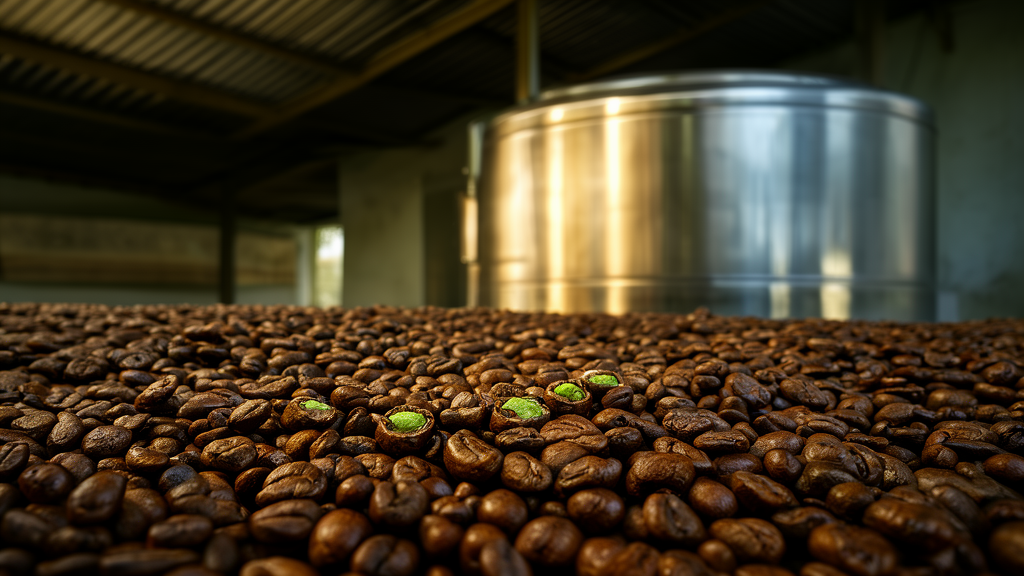
Anaerobic processing changes the environment inside the tank. Exporters put whole or depulped cherries into sealed stainless-steel tanks, sometimes adding specific yeast strains, and then seal them off from oxygen. The fermentation happens in that oxygen-free space. Without oxygen, the yeast and bacteria shift their metabolic pathways. They produce different acids, different esters, and higher levels of alcohol than they would in an open-air natural process.
The result is a bean that tastes sharper, funkier, and more alcoholic. You get notes that standard naturals rarely show: overripe peach, winey alcohol, sometimes even a faint medicinal or solvent-like note that is not a defect but a direct result of the anaerobic environment. The body is often heavier, the acidity is sharper, and the finish is longer. It is not a bad batch. It is a different product.
This is not a minor variation. It is a fundamental shift in how the bean develops flavor. A standard Ethiopian natural from Yirgacheffe might taste like blueberry jam and honey. An anaerobic natural from the same region might taste like overripe peach, red wine, and a faint medicinal funk. They come from the same farm, the same harvest, the same country. The only difference is the tank.
Why Ethiopian Exporters Are Doing This
The answer is simple: differentiation. The global specialty-coffee market is crowded. Standard naturals are everywhere. Every major roaster buys them. Every grocery store with a specialty section stocks them. They are reliable, but they are not unique.
Anaerobic processing gives exporters a way to stand out. It creates a product that tastes different, sharper, and more complex. It allows them to charge a premium. It gives them a story to tell. And it works. The market has responded. Roasters are buying it. Consumers are noticing it.
But there is a risk. Anaerobic processing is not foolproof. If the tank is not sealed properly, if the temperature is not controlled, if the yeast strain is not managed, the batch can go wrong. It can turn into vinegar. It can turn into rot. It can turn into a cup that tastes like a defect.
That is why you see a wide range of quality. Some anaerobic naturals are exceptional. Some are mediocre. Some are bad. The label “anaerobic natural” tells you nothing about quality. It only tells you about the process. You still need to taste the bean to know if it is good.
How to Spot the Difference Between Standard and Anaerobic Naturals
You do not need a lab. You do not need a refractometer. You need your nose and your palate. Here is what to look for.
First, the nose. A standard Ethiopian natural smells like blueberry jam, honey, and sometimes stone fruit. It is sweet, round, and approachable. An anaerobic natural smells sharper. It smells like overripe peach, red wine, and sometimes a faint medicinal or solvent-like note. It is less approachable. It is more complex. It is more challenging.
Second, the taste. A standard Ethiopian natural tastes like blueberry jam, honey, and sometimes chocolate. It is sweet, round, and smooth. An anaerobic natural tastes sharper. It tastes like overripe peach, red wine, and sometimes a faint medicinal or solvent-like note. It is less smooth. It is more complex. It is more challenging.
Third, the finish. A standard Ethiopian natural has a medium finish. It fades gently. An anaerobic natural has a long finish. It lingers. It leaves a faint medicinal or solvent-like note on the palate. It is not a defect. It is a direct result of the anaerobic environment.
Finally, the body. A standard Ethiopian natural has a medium body. It is smooth and round. An anaerobic natural has a heavy body. It is thick and syrupy. It coats the palate. It is not a defect. It is a direct result of the anaerobic environment.
These are not hard rules. They are tendencies. You will find standard naturals that taste sharp and funky. You will find anaerobic naturals that taste sweet and round. But if you taste a cup that smells and tastes like overripe peach, red wine, and a faint medicinal note, with a heavy body and a long finish, it is very likely an anaerobic natural. If you taste a cup that smells and tastes like blueberry jam, honey, and stone fruit, with a medium body and a medium finish, it is very likely a standard natural.
What This Means for Your Brewing
If you are brewing an anaerobic natural, you need to adjust your approach. Standard naturals brew well at a medium grind size, a medium brew time, and a medium water temperature. Anaerobic naturals require a slightly finer grind, a slightly longer brew time, and a slightly lower water temperature. They are more complex. They are more challenging. They require more attention.
If you brew an anaerobic natural like a standard natural, it will taste sharp, funky, and medicinal. It will taste like a defect. It will taste like a bad batch. It is not a bad batch. It is a different product. You need to adjust your brewing to match the bean.
Here is a starting point. Use a 1:16 brew ratio. Grind slightly finer than you would for a standard natural. Brew for 3:30 to 4:00 minutes. Use water at 93°C. Taste. Adjust. If it tastes too sharp, coarsen the grind. If it tastes too weak, fine-tune the grind. If it tastes too weak, extend the brew time. If it tastes too bitter, lower the water temperature. This is not a rigid recipe. It is a starting point. Adjust to taste.
Do not be afraid of the funk. The medicinal or solvent-like note is not a defect. It is a direct result of the anaerobic environment. It is part of the flavor profile. It is part of the story. It is part of why you bought this bean. Embrace it. Adjust your brewing to match it. Taste the complexity. Taste the challenge. Taste the difference.
When Anaerobic Processing Goes Wrong
Not every anaerobic natural is good. Some go wrong. Some turn into vinegar. Some turn into rot. Some turn into a cup that tastes like a defect. This is not a failure of the process. This is a failure of execution. The tank was not sealed properly. The temperature was not controlled. The yeast strain was not managed. The batch was not monitored.
If you taste a cup that smells and tastes like vinegar, rot, or a harsh solvent note, with a thin body and a short finish, it is likely a failed anaerobic batch. It is not a different product. It is a bad batch. Do not brew it. Do not drink it. Do not buy it. Return it. Request a refund. Find a different bag. This is not a learning experience. This is a waste of money.
Quality control is the difference between a great anaerobic natural and a bad one. Look for exporters who invest in quality control. Look for exporters who monitor the tank. Look for exporters who test the batch. Look for exporters who roast the batch. Look for exporters who taste the batch. This is not a luxury. This is a necessity. This is the difference between a great cup and a bad cup.
The Bottom Line
Anaerobic natural processing is not a fad. It is not a gimmick. It is not a marketing ploy. It is a real process. It changes the bean. It changes the cup. It changes the story. It changes the market. It changes the future of coffee.
If you buy an Ethiopian natural, ask yourself: is this standard, or is this anaerobic? Taste the nose. Taste the flavor. Taste the finish. Taste the body. If it smells and tastes like overripe peach, red wine, and a faint medicinal note, with a heavy body and a long finish, it is likely anaerobic. If it smells and tastes like blueberry jam, honey, and stone fruit, with a medium body and a medium finish, it is likely standard. Know the difference. Brew accordingly. Taste the complexity. Taste the challenge. Taste the future.
The label “Ethiopian Natural” no longer means one thing. It means two. It means standard. It means anaerobic. They are different. They taste different. They brew different. They matter different. Learn the difference. Taste the difference. Brew the difference. This is not a minor variation. This is a major shift. This is the future of coffee. This is why you need to pay attention.