
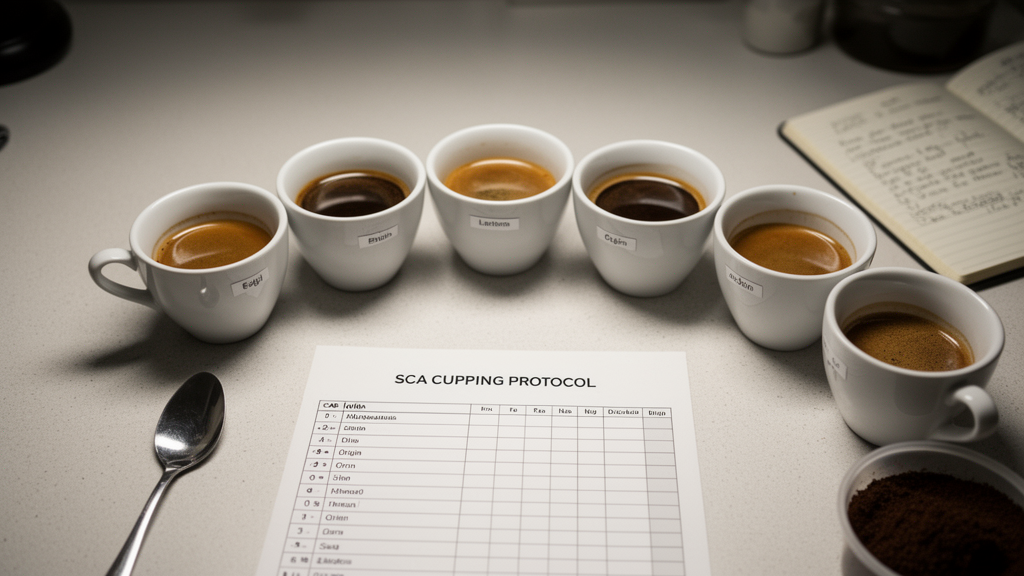
You’ve been told the SCA cupping protocol is how you judge a coffee’s quality. It isn’t. It’s a consistency test. The Specialty Coffee Association’s standardized cupping sheet exists to help professionals agree on what they’re tasting, not to tell you whether a bag is worth your money. When you follow the protocol exactly, you get a score. That score tells you how well the roaster controlled the roast, how consistent the green coffee was, and whether the bean meets a commercial baseline. It does not tell you whether you will enjoy the cup.
The protocol forces every cupper into the same ritual: seven grams of coffee ground to a specific mesh size, 200 milliliters of water at exactly 93 degrees Celsius, a four-minute steep, a crust broken at the same angle, and a slurped sample at 75 degrees. The numbers on the sheet are clean. The cup is not. The SCA score rewards uniformity. It punishes the wild, the complex, and the experimental. A Geisha from Panama that tastes like jasmine and bergamot will score lower than a Brazilian Santos that tastes like clean chocolate, simply because the Santos is easier to reproduce batch after batch.
Why the Protocol Exists
The SCA cupping protocol was never designed for home brewers. It was designed for traders, roasters, and buyers who need a shared language. Before standardization, two buyers could taste the same lot and disagree on everything from acidity to body. The protocol gives them a fixed set of variables: grind size, water temperature, brew time, cup geometry, and even the angle of the spoon. It removes the variables that make coffee personal.
This is not a flaw. It’s a feature. The protocol exists to answer one question: is this lot consistent enough to sell? If a roaster buys 500 kilograms of a Colombian Supremo and gets a 84.5 score one month and an 82.0 score the next, the protocol flags the drift. The protocol does not care whether you prefer the 82.0 cup. It cares that the 84.5 cup is predictable.
What the Score Actually Tells You
A high SCA score means the bean is clean, uniform, and free of defects. It does not mean the bean is interesting. It does not mean the bean will taste good to you. It means the bean passed a quality-control checklist designed for commercial buyers. The SCA score is a measure of consistency, not complexity. A 90-point Geisha is not automatically better than an 86-point natural-process Ethiopian. The Geisha might be more complex, but the protocol rewards the traits that matter to a buyer who needs to restock the same profile next quarter.
The scoring system breaks down into five categories: fragrance, aroma, flavor, aftertaste, acidity, body, balance, uniformity, clean cup, sweetness, and overall. The last three are the real killers. Uniformity measures how consistent the cup is across multiple samples. Clean cup measures the absence of off-flavors. Sweetness measures the presence of perceived sweetness. A bean that scores high on these categories will taste predictable. It will not taste exciting. It will taste like the same cup every time you brew it.
What Home Brewers Should Actually Look For
Home brewers do not need consistency. They need character. The SCA protocol punishes the very traits that make coffee worth drinking at home: wild acidity, complex fruit notes, unpredictable body, and a finish that changes from cup to cup. If you want a coffee that tastes the same every time, buy a commercial blend. If you want a coffee that tastes like something, look for the traits the protocol ignores.
Start by looking at the processing method. A natural-process Ethiopian from Yirgacheffe will score lower on the SCA sheet than a washed Colombian from Huila. The natural process introduces fermentation variables that the protocol penalizes as defects. The result is a cup that tastes like blueberry jam, wine, and fermented fruit. The protocol calls it inconsistent. You call it interesting.
Next, look at the roast level. A light roast will show more origin character, but it will also show more defects. A dark roast will mask defects, but it will also mask origin character. The SCA protocol rewards a roast level that balances both. Home brewers should ignore the protocol and roast to taste. If you like bright, fruity, complex coffee, roast light. If you like chocolatey, nutty, predictable coffee, roast medium-dark. The SCA score will not help you decide. Your palate will.
How to Use the Protocol Without Being Fooled
The SCA cupping protocol is a tool, not a gospel. Use it to understand what a roaster is trying to do. If a roaster scores their beans high, they are prioritizing consistency. If they score lower, they are prioritizing character. Neither is wrong. They are just different goals. The protocol does not tell you which goal is better. It tells you which goal the roaster chose.
When you buy a bag of coffee, look at the score. If it’s high, expect a clean, predictable cup. If it’s low, expect a wild, complex cup. Neither is better. They are just different. The protocol is a map, not a destination. Follow it if you want to understand the roaster’s intent. Ignore it if you want to find a coffee that tastes like something.
Where the Protocol Breaks Down
The SCA cupping protocol breaks down when you apply it to coffee that was never meant to be consistent. Anaerobic fermentation, honey process, and wet-hulled beans all introduce variables that the protocol penalizes as defects. A Kenyan AA that tastes like blackcurrant and grapefruit will score lower than a Brazilian that tastes like chocolate and nuts. The protocol calls the Kenyan inconsistent. You call it complex. The protocol does not care. It only cares that the Kenyan tastes different from the last batch.
Home brewers should embrace the breakdown. The protocol exists for commercial buyers who need to restock the same profile. You do not need to restock the same profile. You need to find a coffee that tastes like something. If the protocol says a coffee is inconsistent, that might be the best reason to buy it.