The Myth of the Floral Cup
Specialty coffee marketing has trained you to expect floral notes. If you order a washed Ethiopian, the menu will promise jasmine, bergamot, and honey. If you order a Kenyan AA, it will promise blackcurrant. If you order a Colombian Supremo, it will promise chocolate and nuts.
This is not a description of the coffee. It is a description of the marketing department’s vocabulary.
The reality of a high-altitude washed Ethiopian coffee, specifically one graded as Yirgacheffe, is not floral. It is a highly structured, intensely acidic cup that home brewers frequently mistake for sourness, then grind finer to fix, and in doing so, completely break the cup. The floral notes are not the primary structural element of the coffee. They are the volatile, fleeting byproducts of a specific chemical stress response that only survives if the brewer understands the mechanics of acidity.
When you brew a Yirgacheffe using standard pour-over protocols designed for a Brazilian or Colombian bean, you are not pulling out the flowers. You are pulling out the acids. And because you are likely using a grind size calibrated for a lower-acidity bean, you are under-extracting the sugars needed to balance that acidity. The result is a cup that tastes sharp, thin, and unpleasantly sour. You blame the bean. The bean is not the problem. Your extraction target is.
What Yirgacheffe Actually Is
Before we get to the brewing protocol, we need to clear up what the name actually means. “Yirgacheffe” is not a single farm. It is not even a single cooperative. It is a town in the Gedeo Zone of southern Ethiopia, and it is also the name of a massive, sprawling region surrounding that town. When a bag of coffee is labeled “Ethiopian Yirgacheffe,” it means the beans were grown within that geographical boundary and processed at a washing station located within that boundary.
Most of these beans are the heirloom varietals native to Ethiopia. These are not the Bourbon or Typica trees you might find in Central America. They are hundreds of distinct, naturally occurring genetic variations that have adapted to the specific soil and climate of the Gedeo Zone over centuries. This genetic diversity is the primary driver of the complex acidity that defines the region.
Altitude is the second driver. Yirgacheffe farms sit between 1,800 and 2,200 meters above sea level. At this height, the coffee cherry develops more slowly. The bean becomes denser. The cellular structure becomes tighter. This density forces the roaster to apply more heat energy to reach development, and it forces the brewer to apply more mechanical energy (via grind size and agitation) to extract the solubles.
When a bag says “Yirgacheffe,” you are buying a high-density, high-acidity, heirloom-varietal coffee. You are not buying a floral tea. You are buying a chemical puzzle that requires a specific key to solve.
The Acidity vs. Sourness Trap
Here is where most home brewers fail. They taste a cup of Yirgacheffe and experience a sharp, bright, almost citrusy sensation on the sides of their tongue. Their brain registers this as “sour.” They assume the coffee is under-extracted. They assume the roast was too light. They assume the water was too cold.
So they grind finer. They slow the pour. They increase the brew time. They are trying to extract more sugars to mask the acidity. This is the exact opposite of what the coffee needs.
In coffee science, there is a massive difference between acidity and sourness. Acidity is a desirable structural component. It is the brightness, the liveliness, the complexity that makes a coffee taste like fruit rather than like flat, roasted water. Sourness is a defect. It is the result of under-extraction, where the lighter, sharper acids (like citric and malic acid) have been pulled from the bean, but the heavier, sweeter sugars (like sucrose and caramel compounds) have not yet dissolved into the water.
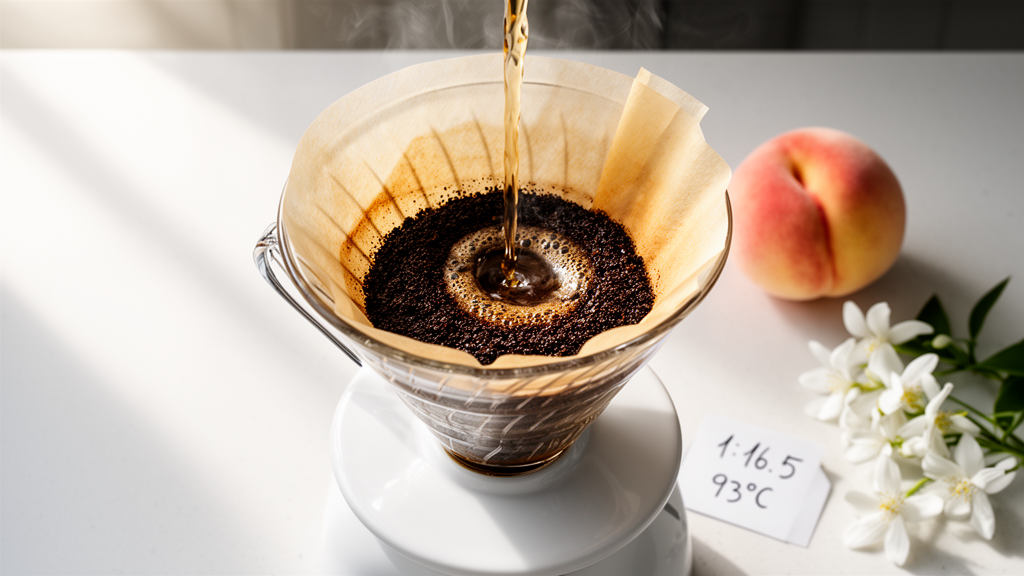
A properly extracted Yirgacheffe should taste like ripe stone fruit, like a peach or a nectarine. It should have a syrupy body. It should have a lingering sweetness. It should not taste like lemon juice.
If your cup tastes like lemon juice, you have not extracted enough sugar. You have not extracted enough of the heavier compounds that balance the high acidity. You have created a sour cup. And the solution to a sour cup is almost never to grind finer. Grinding finer increases the surface area, which increases the extraction rate of the acids even further. You are digging the hole deeper.
The Yirgacheffe Extraction Protocol
To brew a Yirgacheffe correctly, you must accept its acidity as the primary flavor driver. You must stop trying to “fix” it with a finer grind. Instead, you must optimize your extraction to pull out the maximum amount of sugar and body to balance that acidity. This requires a specific protocol that is the opposite of what you would use for a low-acidity Brazilian coffee.
Here is the exact recipe for a 250ml cup of Yirgacheffe using a standard Hario V60 dripper.
1. The Ratio: 1:16.5
Use 15 grams of coffee to 250 grams of water. This is a slightly stronger ratio than the standard 1:16, but it gives you more mass to work with. The high acidity of Yirgacheffe requires a higher concentration of solubles to feel balanced. If you drop to 1:17, the cup will taste thin and sharp. If you go to 1:15, it will taste muddy and over-extracted. 1:16.5 is the sweet spot.
2. The Grind: Medium-Fine, But Coarser Than You Think
This is the most critical step. Set your grinder to a setting that is slightly coarser than what you use for a standard pour-over. If you normally grind at 12 clicks on a Comandante C40, try 13 or 14 clicks. If you are using a Baratza Encore, aim for setting 10 instead of 8. The goal is to allow the water to flow through the bed quickly and evenly, without channeling. A finer grind will trap the acids and prevent the sugars from dissolving. You want the total brew time to be between 2:30 and 3:00 minutes. If it is brewing faster than 2:30, go slightly finer. If it is slower than 3:00, go coarser. Do not grind finer to “fix” sourness. Grind finer to increase body, but only if the cup tastes flat.
3. The Water: 93°C (200°F)
Use water that is hot enough to extract the dense cellular structure of the high-altitude bean. 93°C is the standard recommendation for washed Ethiopians. Do not drop the temperature to “protect” the floral notes. The floral notes are volatile. They will evaporate if the water is too hot, yes, but they will not extract if the water is too cool. 93°C is the temperature that dissolves both the acids and the sugars efficiently. If your machine does not hit 93°C, add 30 seconds to your brew time.
4. The Pour: Agitation is Key
Pour the water in a slow, concentric circle, starting from the center and moving outward, avoiding the very edges of the filter. Pour all 250 grams of water within 45 seconds. Once the water hits the coffee bed, give the dripper a gentle but firm swirl. This agitation is non-negotiable for Yirgacheffe. The dense, high-altitude beans do not release their sugars easily. You must mechanically disturb the bed to ensure even extraction. Without the swirl, you will get a channel down the center, and the rest of the bed will remain under-extracted. The swirl forces the water into contact with every particle.
5. The Bloom: 30 Seconds
Start your timer. Pour 30 grams of water to bloom the coffee. Let it sit for 30 seconds. This releases the CO2 trapped in the dense beans. If you skip the bloom, the CO2 will repel the water, creating dry pockets of coffee that will never extract. The bloom is not optional for high-altitude washed coffees. It is essential.
Why This Matters
Understanding the difference between acidity and sourness is the single most important skill a home brewer can develop. It separates the hobbyists from the baristas. It is the difference between throwing away a $30 bag of beans because you thought they were “bad,” and brewing a cup that tastes like a perfectly ripe peach.
Yirgacheffe is not a floral tea. It is a high-acidity, high-density, high-altitude coffee that demands respect. It demands a specific extraction target. It demands that you stop trying to fix what isn’t broken. If your cup tastes sour, do not grind finer. Grind coarser. Agitate more. Trust the process. The flowers are there. They are just hiding behind the acidity. And once you learn how to pull them out, you will never go back to brewing a Brazilian coffee the same way again.