Two Brews, One Cup
Two identical batches of ground coffee. One brews for 30 seconds. The other sits in water for 4 minutes. You mix them. The result is a cup that tastes like neither the short brew nor the long one. It tastes like a single, perfectly balanced pour-over.
This is the split pour-over method. It is not a gimmick. It is a mechanical solution to a physical problem that every home brewer encounters when they try to extract a complex, light-roasted bean using a standard V60 or Kalita Wave recipe. The problem is that a single continuous pour cannot extract the soluble acids and the heavy aromatic oils at the same rate. The short brew pulls the bright, high-frequency notes. The long immersion pulls the body and the low-frequency compounds. Mixing them creates a composite extraction that a single continuous flow simply cannot achieve.
Most home brewers try to solve extraction imbalance by adjusting grind size. They grind finer to pull more body, which inevitably makes the cup sour and astringent. They grind coarser to tame the acidity, which leaves the cup thin and watery. The split method bypasses this trade-off entirely. It lets you extract the acids and the oils independently, then combine them to hit an extraction yield that sits exactly where you want it.
How Standard Pour-Over Fails at High Extraction Targets
To understand why the split method works, you have to look at what happens inside the coffee bed during a standard continuous pour. When you wet the grounds, you are creating a slurry. The water flows through this bed, dissolving soluble compounds as it travels from the top to the bottom. This process is governed by solubility rates. The acids dissolve first, within the first 15 to 20 seconds. The sugars follow, peaking around the 45-second mark. The heavy aromatic oils and bitter alkaloids take the longest to dissolve, often requiring full contact times of 3 minutes or more.
In a standard V60 pour, you are trying to do all three things at once. You are pouring water through the bed while trying to manage the flow rate. If you pour too fast, the water bypasses the fines, creating channeling. The channeling extracts very little, leaving the rest of the bed under-extracted. If you pour too slowly, you over-extract the fines at the bottom of the bed, pulling out the bitter, astringent compounds before the acids have fully dissolved in the upper layers.
This is why high-altitude beans, like those from Kenya or Ethiopia, often taste unbalanced in a standard brew. The acids are sharp and piercing, but the body is thin. You cannot fix this by grinding finer, because finer grounds increase the surface area of the fines, which leads to more bitter extraction. You are stuck between a rock and a hard place. The split method solves this by separating the extraction phases.
The Mechanics of the Split Brew
The split method divides the total dose of coffee into two equal parts. Let’s say you are brewing 15 grams of coffee for a 250-gram cup. You split that dose into two 7.5-gram portions. You also split your total water into two portions: a small amount for the short brew and a larger amount for the long brew.
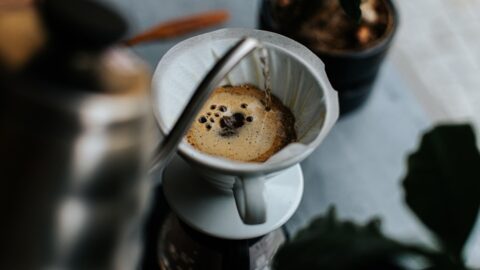
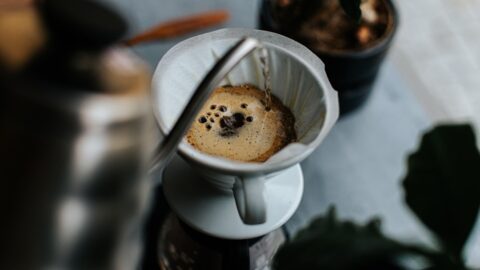
First, you take one 7.5-gram portion and place it in a standard dripper. You bloom it with 15 grams of water for 30 seconds. Then, you let the rest of the water (about 100 grams) flow through. This is your short brew. It is high in acids, low in body, and very clear. It tastes like tea. This is not a mistake. This is exactly what you want. You are extracting the high-frequency notes without any of the heavy compounds.
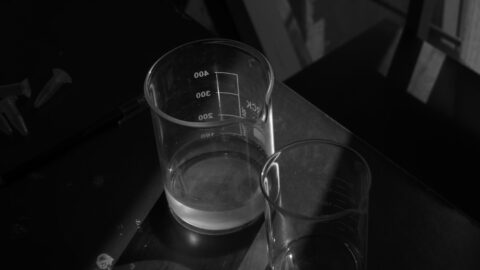
Second, you take the other 7.5-gram portion and place it in a separate vessel, such as a French press or a dedicated immersion beaker. You add 150 grams of water. You let it steep for 4 minutes. This is your long brew. It is high in body, low in acidity, and heavy on the aromatic oils. It tastes like a strong, dark tea. Again, this is not a mistake. You are extracting the heavy compounds without any of the sharp acids.
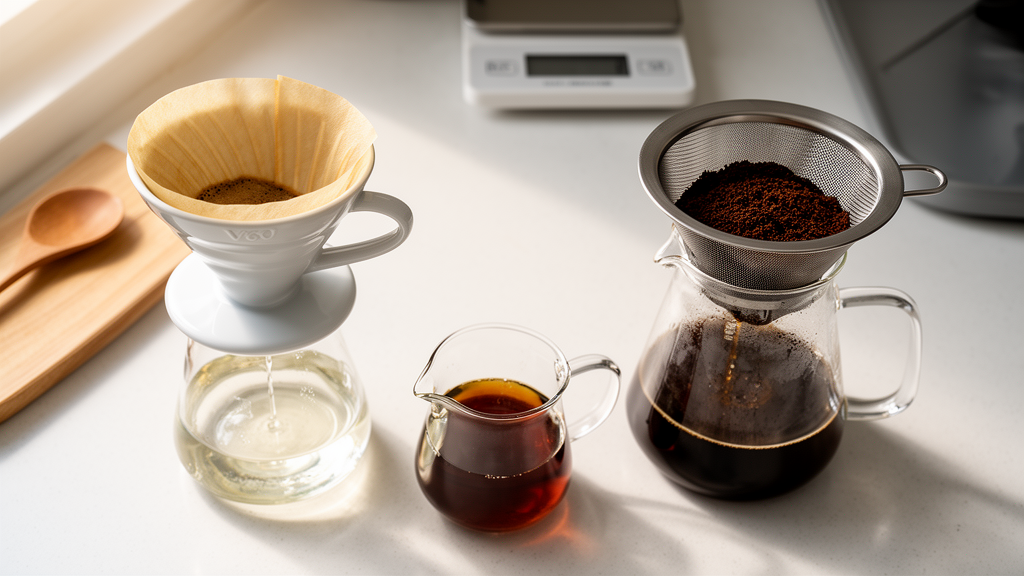
At the 4-minute mark, you discard the grounds from the immersion vessel. You now have two distinct liquids. You mix them together in your server. The ratio is roughly one part short brew to two parts long brew. The result is a cup that has the brightness of the short brew and the body of the long brew. It is a single cup that tastes like a perfectly balanced extraction.
Why This Beats a Single Continuous Pour
The advantage of the split method is that it decouples the extraction of acids from the extraction of oils. In a standard pour, these two processes are locked together. You cannot extract the oils without also extracting the acids. The split method breaks this lock.
This is particularly useful for beans that are difficult to extract. Light-roasted Ethiopian naturals, for example, are dense and complex. They have high acidity and low body. A standard pour often leaves them thin. A split brew allows you to pull the bright, fruity notes from the short brew and the heavy, jammy body from the long brew. The result is a cup that tastes like a medium roast, but with the clarity of a light roast.
It is also useful for beans that are prone to bitterness. Darker roasts, or beans that are roasted past development, often taste bitter and ashy in a standard pour. The split method allows you to pull the bright notes from the short brew and avoid the bitter compounds entirely by discarding the grounds from the long brew before they can over-extract. The result is a cup that tastes clean and bright, without the bitterness.
How to Execute the Split Pour at Home
Executing the split method requires two vessels. A standard dripper (V60, Kalita, or Hario Switch) and an immersion vessel (French press, AeroPress, or a simple glass beaker). You do not need special equipment. You just need two containers.
Start by splitting your dose. Weigh your coffee and divide it in half. Place one half in the dripper and the other half in the immersion vessel. Heat your water to 93°C. This is a standard temperature for light roasts.
For the short brew, bloom the grounds in the dripper with 15 grams of water. Wait 30 seconds. Then, pour the remaining 100 grams of water in a slow, steady spiral. Let it drain completely. This should take about 60 seconds total. Set this liquid aside.
For the long brew, add 150 grams of water to the grounds in the immersion vessel. Stir once to ensure all grounds are wet. Set a timer for 4 minutes. At the 4-minute mark, press the plunger down (if using a French press) or filter the liquid through a paper filter (if using a beaker). Discard the grounds.
Mix the two liquids. Taste. Adjust. If the cup is too thin, increase the ratio of long brew. The split method is highly adjustable. It allows you to fine-tune the balance of your cup without changing your grind size.
When the Split Method Fails
The split method is not a silver bullet. It fails when the bean itself is defective. If the bean is under-processed, or if it has physical defects like quakers or broken beans, no amount of splitting will fix the taste. The split method assumes a high-quality, well-processed bean. It amplifies the qualities of the bean, both good and bad.
It also fails when you lack the patience to execute it. The split method requires two vessels, two timers, and two filtration steps. It takes longer than a standard pour. If you are in a hurry, or if you are brewing for a group, the split method is not practical. It is a technique for slow, intentional brewing. It is for when you want to explore the full spectrum of a bean’s flavor profile.
Finally, it fails when you do not understand the role of grind size. The split method does not replace the need for a good grind. You still need to grind your coffee correctly. The split method assumes a medium-fine grind for the short brew and a medium-coarse grind for the long brew. If your grind is too coarse, the short brew will be weak. If your grind is too fine, the long brew will be bitter. The split method is a tool for balancing extraction, not a substitute for good technique.
The Broader Implication for Home Brewing
The split pour-over method is a reminder that extraction is not a single process. It is a series of overlapping processes. By separating these processes, you gain control over the final cup. You can dial in the balance of acidity and body without compromising one for the other. This is the power of the split method. It is a philosophy of brewing that prioritizes balance over speed.
If you are interested in exploring this further, you might find it useful to look at Panama Geisha brewing requires a different extraction target. Learn why standard recipes fail and how to dial in your pour-over for floral clarity. The split method is particularly effective for Geisha, which demands a high extraction target to unlock its floral notes. You can also check out Your pour-over grind is too fine. It’s not the dripper’s fault. Learn how particle distribution controls extraction, and how to dial in your real grind setting. to understand how grind size interacts with the split method.
The split pour-over method is not for everyone. It is for the home brewer who wants to push the limits of what a single brewer can achieve. It is for the person who believes that coffee is not just a beverage, but a complex chemical system that can be mastered. If you are ready to take control of your extraction, try the split method. You might be surprised by what you find.