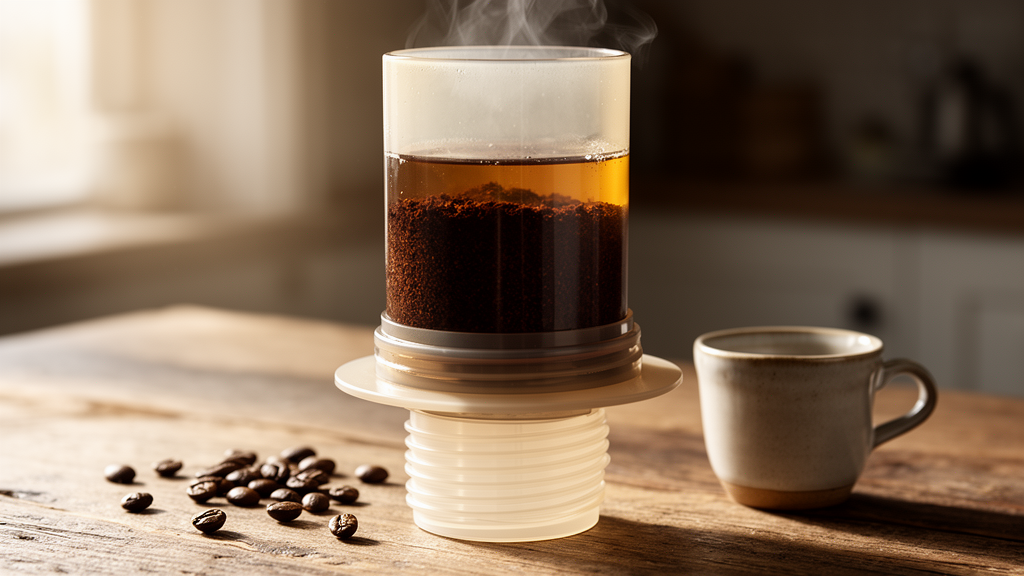
You flip the chamber upside down, the filter cap clicks into place, and suddenly you are staring at a pressurized vessel holding 15 grams of coffee and 200 grams of boiling water. In a standard brew, gravity does the work of pulling the liquid through the bed. In the inverted method, you have to rely entirely on the air-tight seal of the filter cap to keep the water from leaking onto your counter. If the seal fails, the brew is over before it begins. If it holds, you have just created a closed system where time, temperature, and pressure interact in ways that a standard drip brewer simply cannot replicate.
Gravity is the enemy of consistent extraction. When you brew standard AeroPress, water flows through the coffee bed as fast as physics allows. This creates a fundamental problem: the water at the top of the bed extracts faster than the water at the bottom. This is called channeling, and it happens even when you stir carefully. The path of least resistance wins, and the coffee along that path becomes over-extracted while the rest of the bed remains under-extracted.
The AeroPress inverted method eliminates the flow path entirely. The water sits in contact with the coffee for the full duration of the brew. This is full immersion, the same principle used in a French press or a Clever Dripper, but with a critical difference: the AeroPress filter is much finer than a metal mesh, and the pressure you apply at the end forces the liquid through under controlled conditions. The result is a cup that is both clean and full-bodied, without the sediment of a French press or the thinness of a pour-over.
Most home brewers treat the AeroPress as a fast, forgiving alternative to pour-over. They dump in coffee, pour water, wait a minute, and press. The result is often thin, acidic, or uneven. The inverted method forces you to confront the mechanics of extraction directly. It requires a different grind, a different stirring technique, and a different understanding of how pressure affects flavor. When you understand the physics of the inverted brew, you stop guessing why your coffee tastes sharp and start controlling the extraction yield with precision.
Why Gravity Is the Enemy of Consistent Extraction
In a standard AeroPress brew, water flows through the coffee bed as fast as gravity allows.
When you brew inverted, you eliminate the flow path entirely.
The physics here are straightforward but often ignored. In a gravity-fed system, the pressure at the bottom of the bed is determined by the height of the water column. In an inverted brew, the pressure is zero until you flip it and begin to press. This means the extraction happens purely through diffusion, not through forced flow. Diffusion is slower, more even, and less prone to channeling. It allows the soluble compounds to dissolve uniformly across the entire coffee bed, rather than rushing through a single path.
This is why the inverted method consistently produces sweeter, more balanced cups. It is not about complexity. It is about giving the water time to do its job without being forced through a narrow channel. When you remove gravity, you remove the bias that favors certain particles over others. The result is a more complete extraction, with fewer harsh acids and fewer bitter compounds.
The Grind Size That Makes or Breaks the Inverted Brew
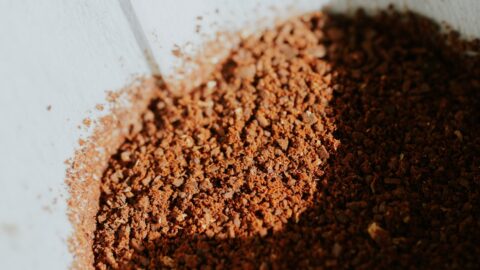
The single biggest mistake home brewers make with the inverted method is using the same grind they use for standard brewing. A standard AeroPress grind is medium-fine, somewhere between table salt and fine sand. An inverted grind must be slightly coarser, closer to the texture of coarse sea salt. If you use a fine grind, the water cannot move through the bed evenly, and you risk a muddy, over-extracted cup that tastes bitter and astringent.
Why does grind size matter more in an inverted brew? Because you are not relying on gravity to pull the water through. You are relying on the pressure you apply at the end to force the liquid through the filter. If the grind is too fine, the filter clogs, the pressure builds too quickly, and the water gets stuck in the bed, extracting harsh compounds that should have been left behind. If the grind is too coarse, the water flows too easily, and you end up with a weak, watery cup that lacks body.
The sweet spot is a grind that allows the water to flow freely but not too freely. It should feel slightly gritty between your fingers, but not sandy. If you are using a burr grinder, aim for a setting that is one or two clicks coarser than your standard AeroPress setting. If you are using a blade grinder, you will need to experiment, but the goal is the same: a consistent, even grind that allows for full immersion without clogging the filter.
This is not a minor adjustment. It is the difference between a cup that tastes like fruit and a cup that tastes like burnt rubber. The inverted method amplifies the effects of grind size because you are extracting for a longer period, under pressure, with a finer filter. Get the grind right, and the inversion method becomes the most consistent way to brew coffee at home. Get it wrong, and you will spend half your morning adjusting variables that should have been fixed from the start.
Stirring Without Creating a Vortex
Stirring is the most controversial part of the inverted method. Some brewers swear by aggressive stirring to break up clumps and ensure even saturation. Others argue that gentle stirring is enough to wet the grounds without creating a vortex that pulls air into the brew. The truth is somewhere in between, and it depends on the coffee you are using.
If you are brewing a light roast, which is denser and harder to saturate, you need to stir more aggressively to break up the clumps and ensure that every particle is in contact with water. If you are brewing a dark roast, which is more porous and easier to extract, you can stir gently to avoid pulling air into the brew, which can lead to oxidation and a flat taste.
The key is to stir in a circular motion, starting from the center and moving outward. Do not stir up and down, which creates a vortex that pulls air into the brew. Do not stir too fast, which creates turbulence that can lead to uneven extraction. Stir slowly, deliberately, and with purpose. The goal is to wet every particle, not to create a whirlpool.
This is not about technique for technique’s sake. It is about controlling the extraction. If you stir too aggressively, you pull air into the brew, which oxidizes the coffee and dulls the flavor. If you stir too gently, you leave clumps of dry coffee that do not extract, leading to a sour, uneven cup. The right amount of stirring ensures that every particle is saturated, every compound is extracted, and every flavor is balanced.
Pressure Release: The Final Variable
The final step in the inverted method is the press. This is where you apply pressure to force the water through the filter. Most brewers press too hard, too fast, which forces water through the bed before it has finished extracting. This leads to a thin, acidic cup that lacks body and sweetness.
The key is to press slowly, steadily, and with control. Do not rush the press. Let the water flow through the filter at its own pace. If the water stops flowing, stop pressing. Wait a few seconds, then resume. This allows the remaining coffee to drain naturally, without being forced through the filter under high pressure.
This is not about strength. It is about control. If you press too hard, you force water through the bed before it has finished extracting, leading to a thin, acidic cup. If you press too gently, you leave coffee in the chamber, leading to a weak, watery cup. The right amount of pressure ensures that every drop of water is extracted, every compound is balanced, and every flavor is present.
When you master the press, you master the inverted method. It is about finesse. It is about understanding that the pressure you apply at the end determines the final flavor of the cup. Get it right, and the inverted method becomes the most rewarding way to brew coffee at home.
Why This Matters for Your Morning Cup
The inverted method is not for everyone. It requires a bit more setup, a bit more attention, and a bit more patience. But for those who want more from their coffee, it is worth the effort. It produces a cup that is cleaner, sweeter, and more balanced than any other method, and it does so without requiring expensive equipment or complex techniques.
If you are tired of thin, acidic coffee, if you are tired of guessing why your brew tastes sharp, if you are tired of adjusting variables that should have been fixed from the start, try the inverted method. It is a physics problem, and once you understand the physics, you will never go back.